Showing posts with label farming with children. Show all posts

Friday, April 5, 2013

Early Spring Surprises


A little madness in the Spring
Is wholesome even for the King.
--Emily Dickinson

Fawn sits . . . and sits . . .
and sits . . .
The week of Spring Equinox and Easter brought with it some lovely surprises to our farm--a couple of which seemed especially appropriate during this season of celebrating new life and new hope. First, one of our Buff Orpington hens "went broody"--that is, she decided she would sit on and care for a clutch of eggs. Of course, my daughters are excited to think they might soon be cuddling baby chicks again. There's a catch, though (as there often seems to be around here). Stripees, the only rooster that remains from the batch we got last spring, seems to be . . . well . . . how can I put this? Less that virile. It's not that he doesn't try to do his job, poor dear; he does--at least a few times a day. It's just that either his small size or his demure temperament (or both) means that after he's danced his flirtatious little jig around the hen he's out to snag and finally ascends those feathery feminine flanks to do his deed, he is more often than not promptly shaken off, and generally with little more than a vigorous shudder on the part of his erstwhile mate.

And so it is that the meek composure that has been key to Stripees' survival in our barnyard (he's the only one of the roosters from last spring's order of chicks that we decided to keep whose aggression didn't eventually land him in a cooking pot), is now leading us to question whether he is capable of passing on his genes to the next generation. If he isn't, then none of Fawn's precious eggs will hatch no matter how long she sits.
Knock, knock--anyone in
there??
To try to figure out whether this was the case, we "candled" a few of her eggs, but while I thought some of them seemed to hold some promise, I wasn't confident enough in my diagnostic expertise to be sure. So we were fortunate to once again be able to turn to a good-hearted neighbor, T. McLeod, at Bradford Farm Stores, who gave us a handful of his own fertilized eggs to set under Fawn just in case her own clutch wasn't going anywhere. So she's now covering a full dozen . . . and waiting . . . and waiting    . . . and waiting. She'll be there for the next three weeks, hardly moving from the spot except for just the briefest of potty breaks and quick bites to eat. And then--if the Spring Fairies are smiling on us--we will have babies on the farm again! Not that we really need more chickens. It's mad, really--wanting more baby chicks. But it's Spring! So come, little ones, and bring us new life.

Kokopelli
The most exciting--and perhaps most mad--thing that happened on our little farm last week, though, was the arrival of Segi and Simi's very own Easter Bunny. I had been working on this surprise for quite a while--plotting his arrival with a friend of mine whose family has owned him since he was
Cuddling with Koko
in his stall
a wee bun but now needs to get him off their hands. (Of course, I'm sure it is true that, as my husband helpfully pointed out, we don't need him any more than they do, but it's Spring! And in any case, he needs us.) I hadn't told the girls anything about him until a couple of days before Easter, when I announced that their Easter Surprise would be arriving a little early this year. That afternoon, my friend and her family rolled into our driveway with Kokopelli, his hutch perched on top of her SUV and all his supplies piled inside. The girls were ecstatic! As their father has insisted, we have him only on a trial basis, while the family is away on a two-week vacation. But of course, all of us girls have rapidly fallen in love with his snuggly-soft, twitchy-nosed little self, so we are all doing our best to make sure the trial goes smoothly.

In the meantime, we have used Koko's arrival as a particularly delightful learning opportunity. We have
Feeding Koko hay
in his hutch
acquired a great deal of knowledge in a very short time about the anatomy and behavior patterns of rabbits. Some of facts we have discovered have been particularly surprising. For example, did you know that many bunnies strongly dislike being held by humans? It makes perfect sense, of course. After all, they are relatively defenseless prey animals whose first instinct is to hide whenever a larger mammal is nearby. But I suppose most of us have been brainwashed by storybooks and children's television programming long enough that we just assume bunnies love nothing better than nestling in anthropomorphic arms. (What a funny ego our species our species has!) The girls and I have also accumulated a lot of tips on rabbit care. And we are learning a great deal about Koko's own particular personality traits, too. (I hope to share more of those in a later post.)

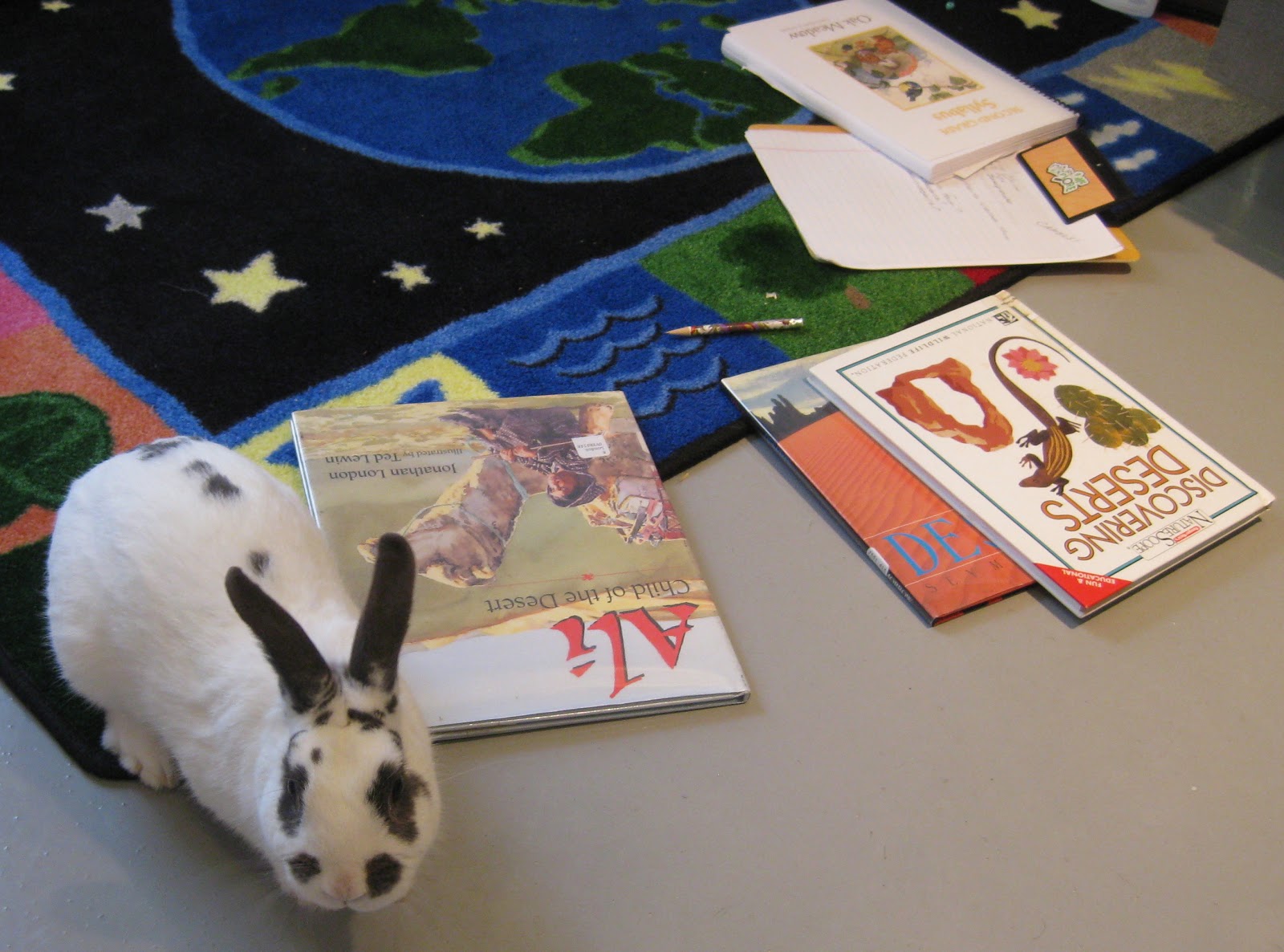
Koko has been learning some, too! Here he is at school with us:

Not bad for a first try, huh?
Great story! Can I have another?


Whew! All this studying is exhausting!
Next week, we are going to make part of our school curriculum studying the meanings and origins of Kokopelli's name and the Native American cultures from which it emerged. We think he'll be especially interested in this topic!

Until then, we will continue spending lots of time during these first few weeks of Spring doting on the newest member of our little farm family and looking after our latest mother-to-be. Welcome, Kokopelli, and good luck mother Fawn!


Thursday, December 6, 2012

Real-Life (and -Death) Learning

Warning: The images and text in this blog might be disturbing to some readers, particularly children. Please read with caution!

"I never let schooling interfere with my education." 
--Mark Twain 


The girls and I had an even less-conventional-than-usual week of school last week. Our schedule specified that our science lessons would focus on animal identification and classification. Instead, we ended up studying the innards and orneriness of roosters.

What happened was this: Over the previous couple of weeks, one of our Delaware roosters, Obadiah Slope, had been getting more and more aggressive, both with the hens and with Segi and Simi.  He hadn't attacked anyone yet, but we were concerned enough to start keeping a close eye on him. Then Monday morning as the girls and I were wrapping up our chores, he cornered Simi, circling her and chasing her into the barn. (Luckily she made it inside before he flew at her.) I knew then that this guy was going into the roasting pan--and soon. That night, I told G-P that the girls and I would set aside our school schedule the next day so we could butcher our erstwhile friend. G-P graciously volunteered to go into work late so that he could catch and dispatch of Obadiah himself. (I have to admit that although I'd talked real big about taking care of everything on my own,  I was immensely relieved not to have to actually wield the machete blow.) To my surprise, the girls walked with their dad through the whole process and never turned their heads. Looks like they really are turning into farm girls!
Bringing in the Carcass 

By 7:30 a.m., our carcass was ready to go. We spent the morning, scalding, plucking, gutting, and chopping. And learning! I invited the girls to participate much more actively in the butchering process this time. And because we had set aside all our plans for the day, we had plenty time to inspect how the feathers attached to the skin; to study what joints look like and how they work; to identify most of the internal organs and discuss their functions; and even to conduct some research into why roosters "turn mean." (We learned, of course, that what humans interpret as roosters turning mean is often a rooster simply being especially devoted to doing his most important jobs: protecting and defending his flock.)

Scalding
Plucking
Examining the Internal Organs
Examining the Joints
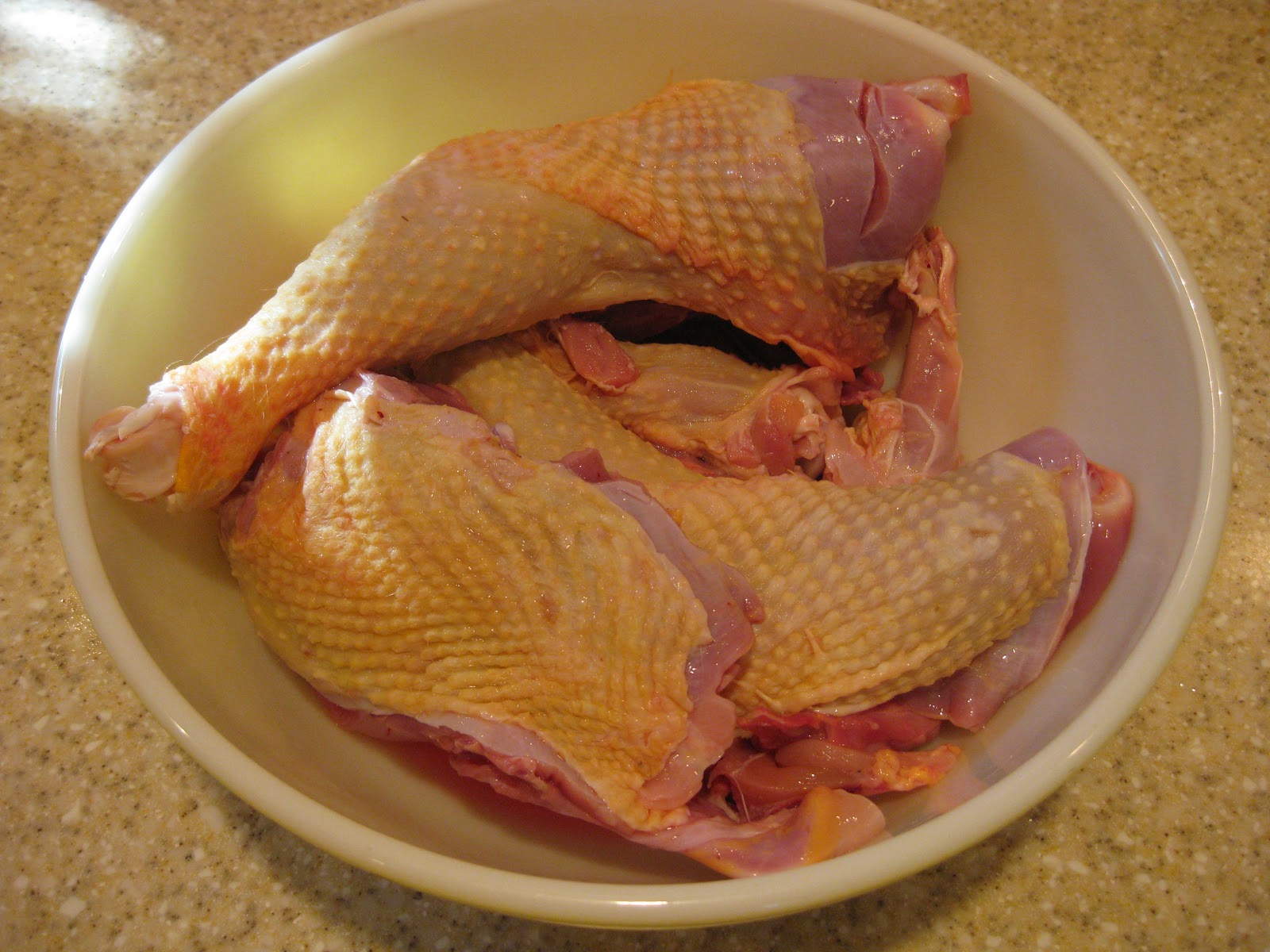
A Major Perk of Our Rooster Practicum: Dinner!

The crisis we faced at the beginning of last week highlighted the fact that if there is one thing homesteading homeschoolers can count on, it is that circumstances will sometimes get in the way of even the best-laid lesson plans.  Luckily, one of the perks of homeschooling is that a derailed schedule can be a just as much an opportunity as it is challenge! That was certainly the case for us in this instance. Indeed, I think I can safely say that the girls and I both learned more from our hands-on exploration of the ill-fated Obadiah than we could have gotten from several textbook chapters on chicken anatomy and behavior.

A key to getting a good education, it seems to me, is being open to "learning where we're planted"-- taking advantage of the learning opportunities that come up in everyday life, even (or perhaps especially) when they interfere with our formal education.

Thank you, Obadiah, for our tutorial. And for dinner!

Thursday, December 8, 2011

Living Dirty

“The love of dirt is among the earliest of passions, as it is the latest. Mud-pies gratify one of our first and best instincts.  So long as we are dirty, we are pure.” --Charles Dudley Warner

“To the illumined man or woman, a clod of dirt, a stone, and gold are the same.”
--from The Bhagavad Gita


I was sitting in the stylist’s chair getting a haircut the other day when it struck me: “I smell like goat.” Maybe that is why the young woman snipping at my hair seemed to be working unusually quickly, even for this quick-cut establishment. Until immersing myself in the fumey aromas of the hair salon, it hadn’t occurred to me to consider how I might be smelling (or looking), but suddenly I became self-conscious. “Here I am in this sparkly clean, fruit-and-flower-scented establishment smelling like stale goat and looking grimy!” Glancing down at my pants, I realized for the first time that day that the goats had been a bit muddy when they climbed onto my legs during the morning’s bottle feeding. And that some straw had stuck to my shoes as I was leaving the mud room (where we keep our barn boots). No one who knows me well will be surprised to learn that I am a pretty low-maintenance gal when it comes to everyday primping. In fact, I probably spend less time in the bathroom getting ready in the mornings than my husband does. But I do like to be clean and smell decent most of the time. And that just doesn’t seem to be happening these days.

The same goes for my girls. They rarely make it past 7:30 a.m. without having some form of crud on their clothes (they’ve already let out the chickens and bottle fed the goats by then, and have probably made several detours into the pasture on their way to and from the barn). The other night the three of us had to go back out to the barn after the two of them had already had their baths and gotten on their pajamas. Somehow they ended up returning to the house half-an-hour later with smudges of dirt all over their pjs, mud on their feet, and hay in their hair. And, of course, smelling like goat. I believe it was the evening after this incident that my husband proclaimed, “I don’t think I like the way goats smell.” I’m afraid what he really meant was he didn’t like the way his wife and his daughters smell. 
Luckily for the three of us, we don’t mind all that much. Maybe not enough!

Perhaps it doesn’t bother me much because I’ve kept in mind all these years what my mom used to tell us kids occasionally: There are two kinds of dirt: dirty dirt and clean dirt. Dirty dirt is the kind of dirt you pick up on city streets; it’s the stuff that makes the snow drifts in New York turn grey in the winter and makes the summer air hazy in L.A. Clean dirt is the kind of dirt you pick up from hiking in the woods, climbing a tree, or tilling a garden. The latter might make you messy, but it doesn’t soil you. It should be washed off at the end of the day, but not fretted over in the meantime.

Running a farm, even one as small as ours, means living dirty. The dirtiness of farm life, though, is not so much an absence of cleanliness as it is a manifestation of intimacy with the animals and plants the farmer raises and with the dusty-muddy-gritty ground that supports and sustains them. A recently published book by Kristin Kimball illustrates this point beautifully. Called The Dirty Life: A Memoir of Farming, Food, and Love, it chronicles Kimball’s transformation from New York City journalist to rural farmer. One of the many adaptations she had to make along the way was coming to accept--and eventually embrace--being almost constantly dirty.

If, like Kimball, our family lived way out in the country, it might not matter very much if we sometimes went around flecked with muck and stall bedding. But we live in a college town—a town with museums, a nice library, and a plethora of culturally enriching activities. A town with several sushi bars and trendy cafes but no feed store for miles. It’s a great place to be. But not a great place to be dirty.

So from now on, I'm going to be more diligent about checking the mirror before I head off to town—or to dinner with my husband. But the rest of the time I'll be relishing dirt and the chance to live in it and know it intimately: to feel it, to smell it, and to accept its gift of connection to the earth and all the earth’s creatures.

"I bequeath myself to the dirt to grow from the grass I love. If you want me again, look for me under your boot-soles."--Walt Whitman


A Little Dirt Never Hurt 
(Author Unknown)

I don't want Sundaes, they're too Sweet,

And Cheetos are too hard to eat!

I've had my fill of Jello too.

But wait, I've tasted something new!

It's not too sweet upon my face,
It's outdoors in my favorite place,

To try all kinds of dirt-filled treats,

Like soil, sand and bugs to eat.


Wednesday, November 23, 2011

New Kids on the Farm

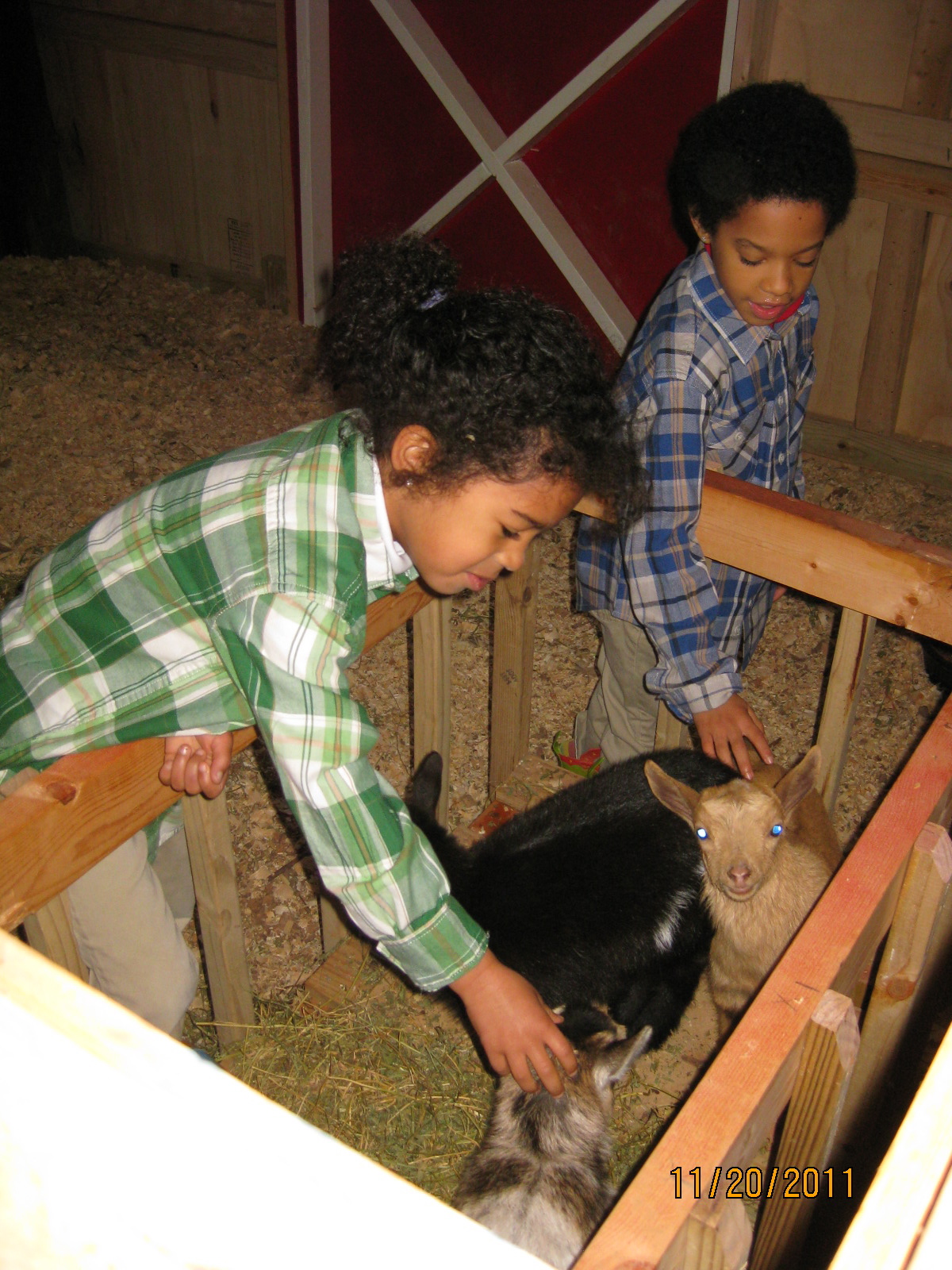
Our girls welcome home Carolina, Tennessee Spot & Tutu
Last Saturday my husband and I took our daughters to a small town just east of Charlotte, NC to pick up the newest members of our farm family: three four-week-old Nigerian Dwarf goats. Little did we know just how thoroughly they would fill the next few days with their needs and antics. What we did know was that we were all smitten with these adorably fuzzy little bundles of spunk. Perhaps if we'd known a little more, we would have thought twice about bringing them back home with us when we did. Our experiences the past few days have illustrated in comic proportion  the truth of Alexander Pope's assertion that "a little learning is a dangerous thing." Let me confess at this point that a good deal of the farming I "know" so far comes from . . . well, from books. As a former professor, I'm pretty comfortable with that sort of knowledge. But I imagine most any farmer you ask would doubt just how thorough such knowledge could possibly be.

As always, I had dutifully done my research. I knew that Nigerian Dwarfs are a small breed of dairy goats originally from West Africa, and that they were first brought to the United States in the early 20th century (some say on ships transporting large cats in order to serves as lion kibble--seriously).  I knew that they have a reputation for being gentle and easily trainable; that they are capable of giving a surprising quantity of milk given their size; and that the high butterfat content of that milk makes it ideal for making cheeses and soaps. I knew, in sum, that they are a perfect fit for a small farm with small children--and thus, just right for us. BUT . . .

Those of you who are parents might remember bringing your little one home from the hospital (or taking her/him from the arms of the midwife) and thinking, "This doesn't seem like it's going to be as tough as everyone's been telling me!" After all, what could possibly be so difficult about clothing and feeding a thing so tiny and lovely? That was, of course, before you tried to slip a cotton onesie over four flailing limbs and a screaming head. Or endeavored to get a stiff synthetic diaper wrapped straight and snug around a bouncing bottom. Or attempted to fill a twisting, spitting mouth with gooey glumps of rice cereal. If you know what I'm talking about, you'll believe me when I say that trying to bottle feed three baby goats who've spent four weeks growing accustomed to nursing with their mamas is not a task for the faint of heart.

We had not signed up originally for bottle feeding duty. On our first trip to visit the farm where they were born, we put down a deposit on them and agreed with the breeder** that we would return to fetch them when they were weaned (around 8 weeks of age). However, once we returned home from that trip, our well laid plans rapidly fell by the wayside. We found that now that we had seen them, held them, and downloaded photos of them to "ooh and ahh" over, it was going to be nearly unbearable to wait another 4 weeks to bring them home. My research had also indicated that kids who are bottle fed by humans are generally easier to milk and to train than those exclusively fed by their dams (that's goat language for mamas).


So off we went to get them 4 weeks early. The drive was no less full of delighted anticipation than Christmas Eve. Our daughters had each been allowed to pick a goat of her own, so they chatted away about the names they had chosen and the many ways they were going to love them and care for them. I, meanwhile, looked over the the questions I wanted the to ask the breeder and lengthened my formidable list of supplies we would need from the feed store. My husband, in an attempt to temper the plans and shorten the feed store list, gave us all another couple of his "Our goats back in Nigeria never had [fill in the blank] and they were fine" lectures.

Once we arrived, the breeder kindly offered us (along with a very helpful--if somewhat intimidating--handout of information and tips) a couple of containers of their dams' milk. She reminded us that it might be difficult to get them to take it from the bottle. Yes, yes, I know, I thought. I had read about that. But I had also read that if you just keep at it, they'll learn. I therefore was not as worried as I probably should have been when she offered to let us return them to her farm for a while "if things don't go well and you get worried about them."

The 50-minute ride back home was remarkably peaceful. I had expected them to bleat and yell and cry for the mothers from whose bosoms we had just snatched them. (Have you ever heard a goat kid cry? If not, you've missed some real drama.) But for the most part, they settled placidly into the pet cage and snuggled up with each other, only sporadically letting out little bleeps of distress or alarm. Neither did they seem particularly upset or disoriented when they were released into the freshly prepared stall that would be their new home. They looked around, hopped right up into the manger (guess it's going to be a playground instead of a manger for a while), and then called for us to come back when we left them to go grab some lunch.

I really think this is going to go just fine, I thought, as I warmed the milk for them a couple of hours later and snipped the new goat and lamb nipples just as the instructions said. Of course, you can guess the rest. For the past few days, we have dutifully walked out to the barn morning, noon, and night, armed with bottles of warmed milk, and fought tooth and nail with these little critters to take it. They have bawled, they have screamed, they have kicked, they have jumped. They have spit and pooped and peed. All while we've tried to hold them as gently as humanly possible and coax them to get a few drops down their throats. Morning, noon, and night I walk back to the house with milk all over my shirt, drool on my neck, mud on my pants, and bits of hair missing from my head (they evidently find human hair delectable--go figure). Yesterday evening, finally, we found more than a fraction of milk missing from each bottle when we finished the feeding. Today has not been as successful so far. Luckily they are eating their concentrate, drinking water, and nibbling at the hay. And they're full of energy--already chasing after the chickens, bouncing gleefully across the pasture, and climbing all over the rock pile in the barnyard. So I'm not lying in bed all night long wondering if they are okay. In fact, I have to admit that they seem just fine. But we'll keep trying to get that milk down them. After all, I learned that we're supposed to in my books.


Tennessee Spot offers a typical reaction to our efforts
My big sister lends us a much-needed hand
Tutu starts to catch on!

** We would highly recommend the breeder we worked with to others interested in raising Nigerian Dwarf Goats. You can find information about her farm and her herd at http://www.five-pointsfarm.com/.