Showing posts with label children. Show all posts

Saturday, September 29, 2012

Living Imaginatively: Lessons from Little Ones

To make a prairie it takes a clover and one bee,
One clover, and a bee,
And revery.
The revery alone will do,
If bees are few.
--Emily Dickinson, Poems

"If a child is to keep his inborn sense of wonder, he needs the companionship of at least one adult who can share it, rediscovering with him the joy, excitement and mystery of the world we live in."--Rachel Carson, in The Sense of Wonder.

"Oh, Mama, doesn't that last line just give you a thrill?!" my 7-year-old exclaimed. "Uh . . . oh, yes,  sweetie." Waking from my ruminations, I realized I hadn't heard a word of it. "Now what was that line again?" I asked lamely. As is often the case on our daily after-school walk to the mailbox, my two girls had spent nearly the whole 10-minute trek talking incessantly while I somehow managed to "Mmm hmm," "Wow," and "Really?" in fairly appropriate places without paying any real attention.

Segi's enthusiastic question suddenly made me realize that, though the three of us were walking side-by-side down the same lane, and occasionally even interacting, we were having radically different experiences. There I was, making mental checklists of to-dos, fretting about not-dones, and otherwise obsessing over the trivial details of our everyday lives, while they were formulating and enacting heroic adventures: testing strategies; negotiating complicated relationships; traveling through time and across continents; and waging battles of good vs. evil.

Is it possible that this stark phenomenological contrast could hold a lesson for us chronically ruminating (and these days, texting and web-surfing) parents? Perhaps we should be asking ourselves how often it is that we are together with our children without really being present with them. We might find that it is more often than is good for them--or for us.

Logic will get you from A to Z; 
imagination will get you everywhere.
--Albert Einstein

How would the quality of my own life be affected if I added even a fraction of the imagination and creativity my daughters employ to the ways I think and act? It would certainly be more exciting--and perhaps a little less stressful. After all, I suspect it is hard to get terribly out of sorts about forgetting to pick up bananas at the store if you're busy working out how LaDansa will save the child locked in the burning apartment building.

. . . Who, you may ask, is LaDansa? She is just one of the many characters Segi and Simi have created in their daily "playings" (their own term for the dramas they script and act out). Perhaps meeting her and a few of the other prominent characters will help me clarify what I'm trying to get at here. So here goes:  . . .
  • Gilbert: A bumbling fire chief who blusters about, issuing unreasonable orders and meting out ridiculous penalties to those who don't meet his expectations. Unfortunately, he is also completely inept and--to top it all off-- has a habit of singing off-key every time he takes a shower. (Many of the stories are set at the fire station, and many of the characters are part-time firefighters.) 
  • Chrysanthemum: Gilbert's co-chief and sister, she is everything he is not: competent, fair, and effective. She scolds him on occasion and runs to hide under her desk whenever he starts to sing. 
  • LaDansa: One of the firefighters, LaDansa was born in a barrio in Mexico to her loving but impoverished parents, Wheat and Martha. She is the "Super Woman" of the drama, often performing über-human feats while generally maintaining heroic integrity. Her one major weakness is that she despises Elizabeth, who is from Spain, because Spain colonized Mexico.
  • Buttercup: She is LaDansa's little sister and--strangely enough--is from rural East Tennessee. (The family's move from Mexico is a long and complicated story; I'll spare you the details.) She loves to lie down in fields of buttercups and read library books.
  • Cherry: Perhaps the most sinister of all the characters, she thinks she is better than all the other firefighters because she is (she claims) from Scotland. In her affected British accent, she constantly denigrates her colleagues, and sometimes does others outright harm. The only person who escapes her wrath is Charles, on whom she has an incurable crush.
  • Charles:  Born a prince of the esteemed royal family of Peaceland, Tennessee, he enjoyed a privileged childhood. But some years ago, Charles' parents were murdered by an unknown assailant. After the attack, Charles ran off into the woods and took up residence in a hollow log. He prefers communing with animals over socializing with other humans. He does not have a crush on Cherry. Instead, he is in love with her daughter, Aniponi, who is much closer to his own age. In fact, they recently married. His most famous faux pas resulted in the prominent scar he bears on his chest. At first it appeared to everyone to be evidence of his heroic escape from his parents' murderers, but it turns out that he incurred it while in dance class. He had been laughing at Buttercup for slipping and falling, and was bragging, "Of course, I never fall!" At that very moment, he fell right out the window and crashed onto the rocks below--just like, Buttercup noted, "a flat balloon."
  • Aniponi: Cherry's daughter. She's 20 years old, pretty, smart, and very nice. Needless to say, her mother does not approve of her relationship with Charles and, in fact, did not show up for their wedding.
  • Elizabeth: Born Spanish through no fault of her own, is a detective. She is a good detective but recently had a setback when she got attacked and bitten by Chocolate, the firehouse beagle. She is good friends with Caddie.
  • Caddie: One of the newest characters, Caddie is very bright and good-hearted. She is a tomboy from Iceland. She thinks that being a tomboy means being a cross between a boy and a girl, but this doesn't bother her: she embraces her mixed identity.
  • Francia: Not surprisingly, she is from France. She is the chief detective. She likes whiskey a bit too much, but despite her indulgences, is good at her job. She is LaDansa's best friend.
  • Copy and Copy: Two of the youngest firefighters, they are twins, and copy everything each other (and often everyone else) does.
Some of these characters have been around for more than two years now, and other ones have emerged only recently (characters are constantly being created, refined, and on occasion, chucked). The girls also have three different make-believe lands they've conjured up: Sunshine Land (populated by itsy-bitsy people who live much our ancestors did in the 19th century), Flower Land and Peace Land (where Flower Language and Peace Language are spoken, respectively). Then there is Ragamuffin, the sock fairy who lives on Segi's left shoulder and sneaks family members' socks while we sleep. (She only borrows them, Segi insists; she never steals.) And the fairies and unicorns we sometimes glimpse during our hikes through the woods. And, of course, The Jolly Roger Pirates Gang. Composed of characters based largely on livestock we've had here at the farm but have had to get rid of for one reason or another (the 3 Nigerian Dwarf goats, the rooster Captain Haddock, and Ellie Mae, the wayward donkey), this group travels the world carrying out all kinds of naughty tricks on unsuspecting farmers.

Fairy Tales are more than true;
not because they tell us that dragons exist, 
but because they tell us that dragons can be beaten.
--G.K. Chesterton

When my girls and other young children immerse themselves in make-believe worlds and act out imaginary dramas, they are not just goofing off. They are also mastering importance social and intellectual skills. In the abstract to her article, "The Role of Pretend Play in Children's Cognitive Development," Doris Bergen of Miami University writes,
there is a growing body of evidence to suggest that high-quality pretend play is an important facilitator of perspective taking and later abstract thought, that it may facilitate higher-level cognition, and that there are clear links between pretend play and social and linguistic competence.
Unfortunately, kids these days are engaging less and less in such pursuits. Lengthening school days, then homework afterwards; a wide array of extracurricular activities; and endless opportunities to "plug in" to computers, televisions, cell phones, and other hand-held devices--all this leaves very little time for wandering around dreaming up fanciful adventures.

Our family has come to think that one of the best things about homeschooling is the unstructured time it gives us: time for thinking, time for dreaming, time for working, time for playing, and time for just being together doing nothing much at all. It's in some of those times (like on our walks to the mailbox) when the very best moments of our days often happen. That is, when I'm not too busy "doing" inside my head to actually notice.

Here, then, is yet another opportunity to learn a significant lesson from my children--and, it turns out, from Dr. Seuss, Gloria Steinem, Carl Sagan, and Albert Einstein.

Think left and think right and think low and think high.  
Oh, the thinks you can think up if only you try!
--Dr. Seuss, Oh, the Thinks You Can Think!

“Without leaps of imagination or dreaming, we lose the excitement of possibilities. 
Dreaming, after all is a form of planning.”
--Gloria Steinem

“Imagination will often carry us to worlds that never were, 
but without it we go nowhere."
--Carl Sagan

“I am enough of an artist to draw freely upon my imagination. Imagination is more important than knowledge. Knowledge is limited. Imagination encircles the world.”
--Albert Einstein

Thursday, June 21, 2012

Farm Camp

 What do you get when you add together 40 chicks, 8 hens, 3 goats, 1 donkey, 20 kids, and countless bugs, dirt, and creek water? Little Bent Creek Farm Camp!

Last week was an especially exciting and eventful week here at the farm as we hosted one of Woodland Discovery's 2012 summer camps. (For information about other Woodland Discovery summer camps, click here.) Carolyn Walker, Woodland Discovery director and camp leader, had lots of fun, engaging, and educational activities planned. A central part of the Little Bent Creek Farm Camp experience was doing daily chores (grooming animals, feeding hay, cleaning stalls, weeding, and so forth). This was completely new stuff to most of the kids, but they all managed to contribute in some way (sometimes very creatively!) to nurturing the animals and/or tending the garden. They also spent time doing crafts, baking, playing games, singing, experiencing new tastes and sounds, and studying a variety of topics--including farm animals, local wildlife, organic gardening, and environmental stewardship. I think it's safe to say that we all learned a great deal from one another.

All of the photographs below were taken by Patti McKinnon, who, along with her son Niall, provided invaluable assistance to "Ms. Carolyn" and me throughout the week.

Singing and Dancing Together
Grooming the Goats
Chatting with the Goats

Getting to Know the Donkey
Riding the Donkey
Cuddling Chicks
Grinding Wheat
Making Homemade Bread
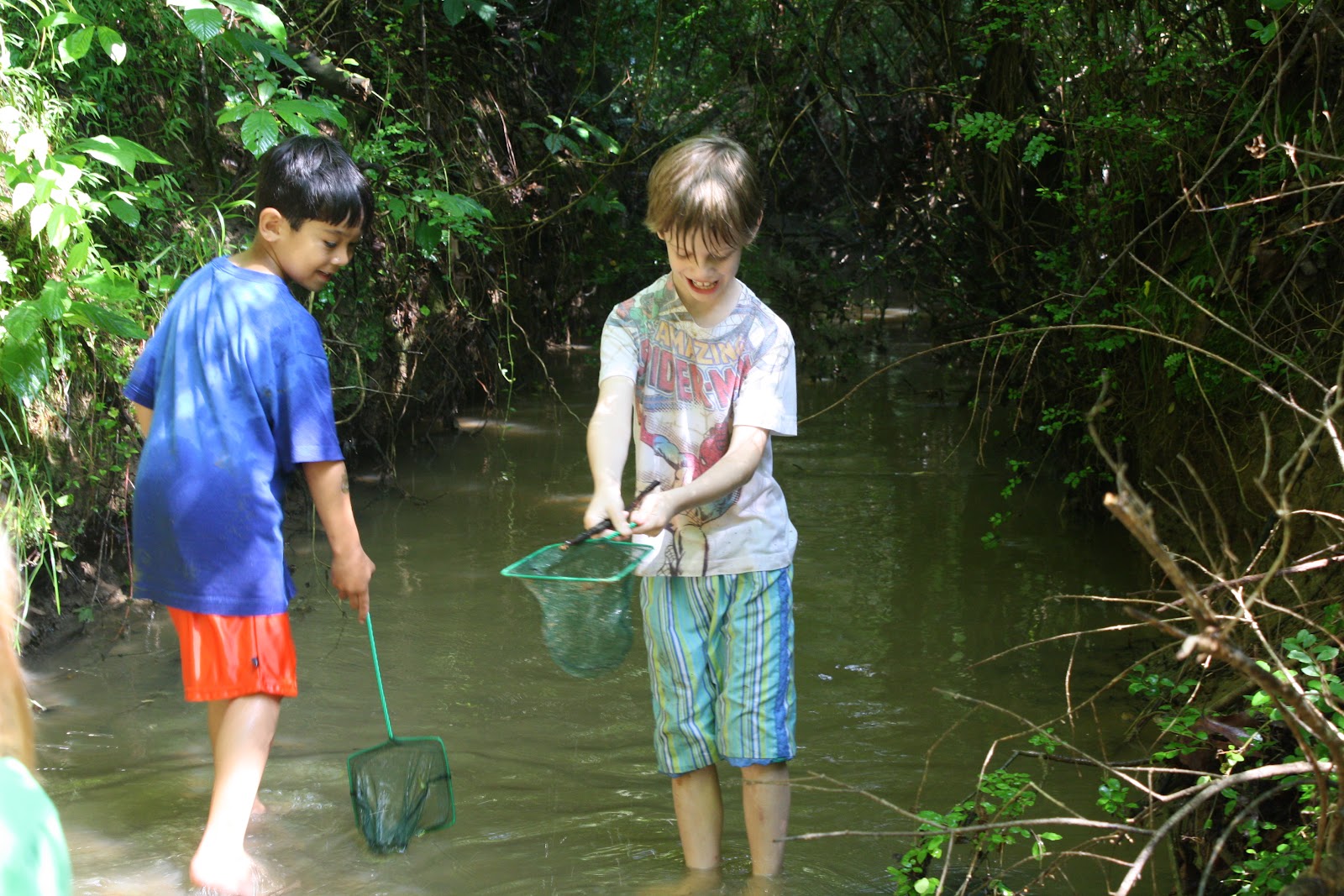
Exploring the Creek
Hunting Tadpoles and Minnows
Touring the Garden
Weeding the Garden
Harvesting Produce
Enjoying a Peaceful Moment Among the Three Sisters
Listening to the Sounds of a Farm
Gathering Sticks
Saying Goodbye 
We'll miss you!


Thursday, June 7, 2012

Farming Ants


The girls started a new industry at our little farm recently: ant husbandry. A couple of weeks ago, they ran inside asking for some plastic containers for their new livestock. "New livestock?" I asked, not sure if I should be alarmed. "Hmmmm. That sounds interesting." "Yes!" they excitedly confirmed, "We're going to raise ants!" Their Auntie Jules (who was with us for another fun-filled working weekend) quickly grabbed several items from the cupboard to give them, and they happily rushed back outside.

Evidently, Segi and Simi had been immersed in their make-believe "playings" in the Enchanted Garden--their name for the little wooded garden area near the bird fountain in front of the house--when they found a few ants crawling around on the ground underneath them. They had quickly agreed that these creatures needed some extra TLC. So they laid down some bedding, put out bottle caps for water troughs, and for feed buckets, set out the plastic containers Jules handed them. Now at each meal of the day, Segi (the 7-year-old) not only lays aside a bit of food for Ragamuffin (the fairy who rides around on her shoulder and sneaks our socks at night) but for the ants as well. She's given them lots of apple, banana and pear bits, as well as pieces of bread, crackers, cookies, chips, pretzels, and vegetables. She says that their favorite food so far is banana slices.

Luckily, it's not too complicated to figure out what to feed members of the formicidae family. They are tiny but voracious omnivores, and even though they are partial to sweets, they will consume nearly anything that has the potential to nourish them: seeds, oils, fruits, vegetables, and sometimes other insects and dead animals. This dietary flexibility has allowed them to thrive on all the world's continents except for Antarctica. Their eating is generally a communal, cooperative endeavor. According to the article "What Do Ants Eat?" at eHow.com,

Ants will utilize scouts to locate food and then lay down a trail for the rest to follow back to it. They accomplish this by using chemicals called pheromones, which they lay down after finding something to eat. They will eat what they find and then head back to the colony where the pheromones will cause the other ants to get worked up and leave to follow the trail back to the source. They will use their antennae in the air and locate the trail, eventually establishing a path that the rest of the colony can easily follow. The ants need to do this quickly before ants from other colonies discover the food.

Some ants also work together as farmers! Ants whose preferred food is honeydew, a sugary-sticky liquid produced by plant-eating aphids, have been know to collectively raise aphids both for their honeydew and for meat. Researchers at the Imperial College London discovered a few years ago that ants sometimes seem to be sedating their itty-bitty livestock to better control them. According to the study (cited in this 2007 article in Science Daily) they "use the tranquillising [sic] chemicals in their footprints to maintain a populous 'farm' of aphids close to their colony, to provide honeydew on tap." Wow--who knew ants were such complex, fascinating creatures? Actually, quite a lot of biologists, including the founder of sociobiology, Harvard professor and renowned author, E.O. Wilson. But of course, most of the rest of tend to assume they're just another one of those irritating little creatures better shooed from the picnic table than attended to.


Children can teach us so many, many things. One of the most valuable lessons my own kids have taught me (over and over again--like most adults, I need repeated instruction before most lessons even begin to sink in) is the value of looking with wonder and appreciation at objects and beings we've grown to consider mundane and thus uninteresting. When we allow ourselves to do so, the world immediately becomes a much richer place to be. Suddenly, the constant planning, calculating, and fretting most of us spend so much of our time immersed in gives way to awe, and we can--if only for a moment--be truly present. I think this must be the revolution that Alice Walker urges us toward in her poem, "We Alone."

We alone can devalue gold 
by not caring 
if it falls or rises 
in the marketplace. 

Wherever there is gold 
there is a chain, you know, 
and if your chain 
is gold 
so much the worse 
for you. 


Feathers, shells 

and sea-shaped stones 
are all as rare. 


This could be our revolution: 

to love what is plentiful 
as much as 
what is scarce.

Wednesday, November 30, 2011

Real Work, Fun Times

"The child becomes a person through work." --Maria Montessori, physician and educator


A few weeks ago, my twin sister and her daughter came to spend a weekend with us. For my girls, having their Auntie Jules come to visit is a little like getting a trip to the amusement park without having to leave home. She is one of those rare adults who actually remembers what it was like to be a kid. She tells goofy jokes; she tickles; she teases; she plays hide and seek; she gets everyone (including herself) in trouble with the other adults; and--most incredibly to me--she seems to thoroughly enjoy all of it. For her, hanging out with kids is not exhausting but invigorating. And they know it. They LOVE it.

Jules is also pretty good with hammers, drills, screwdrivers, and power saws. My academic husband and I are--well, let's just say we are not. (He may beg to differ, as he often insists that he is actually quite skilled with all such tools. I'm remaining skeptical until I see him actually do something with them.) When Jules comes to visit, then, she tends to get strapped into putting things together, hanging things on walls, and fixing things we have broken. Among the tasks I had lined up for her that weekend was helping me hang some heavy tool racks in the garden shed and the barn. It was a surprisingly time-consuming job and one that took us the better part of an afternoon. But we got finally got them up straight and secure. And it felt great.

While we were working, the three girls (her 4-year-old and my 5- and 7-year-olds) came to ask Jules if she could help them build a secret hideout out of some of the planks and boards left over from the barn construction. My girls had been "building" things with these pieces for a couple of weeks--cobbling together houses, a playground, paddocks, and so forth. But now that they had seen us at work, they wanted to do some real building--the kind with hammers, screwdrivers, and saws. So of course, Jules followed them down to their work site in the pasture and stayed there for more than an hour helping them to put together their hideout. I have rarely seen such serious, concentrated labor. They hammered, measured, screwed, sawed, checked the level, made adjustments, and then stood back to admire their work. They were elated.


Later, after their aunt and cousin had gone back home, I asked the girls, "What was your favorite part of the weekend?" You can probably guess their answer. Even though they had played endless games, marched in a parade, seen a video, put on a super-silly play, been read to numerous times, and been taken to get ice cream--with sprinkles--they immediately responded that their favorite part of the weekend was building the hideout with Auntie Jules.

Why is this? Because kids love to do real work. Not all the time, of course (as any parent who has begged his child AGAIN to clean up her bedroom will attest). But in general, kids get a great deal of satisfaction out of doing meaningful labor. Unfortunately, this is one of those things that most of us adults have forgotten about childhood. We assume that kids want to play. And to some extent we are right: they do want to play. They need to play and ought to play. But for kids, doing real work can be the best kind of play. My girls, for example, enjoy playing chef. So occasionally I let them drag my mixing bowls, measuring cups and spoons, and cutting boards out of the kitchen cabinets and set up a pretend kitchen in the den. They pour, stir and chat, chat, chat as they concoct elaborate dishes for their dad and me to "taste". This is fun. Yet most days both of them would choose instead to help me mix up a real cookie batter, or chop vegetable sticks for their own lunch, or knead dough that they will later smell baking in the oven.

Maria Montessori, Rudolf Steiner and Charlotte Mason (along with other 20th century pioneers of alternative education) recognized children's enthusiasm for worthwhile labor. Building upon that enthusiasm, in fact, formed a key component of their educational philosophies. Today, though, our society generally ignores and sometimes even actively discourages children's interest in doing real work. Perhaps this is because many of us big people assume that little people are much less capable of constructive tasks than they actually are. Why on earth do we assume that a 4-year-old who can master a new video game in a matter of minutes is unable to break an egg into a bowl? Or that a kindergartener who can glide effortlessly around the park on her new scooter is incapable of making up her own bed?

Of course, farming families around the world have known for centuries that kids can play a variety of essential roles in maintaining the wellbeing of a family and a community. But we are--most of us--no longer farmers. And our kids more often than not "get in the way" when they try to help. We occasionally humor them and allow them to make a couple of strokes with the paint brush or move the broom around the floor a few while, but when it's time to get serious work done, it's our turn.

I believe we ought to try handing back the brush and the broom and giving them a chance. We may just find that doing so will leave us all better off--and happier--in the long run.