Saturday, January 28, 2012

Pre-Spring Presentiments

Spring is in the air this last weekend in January. The sun is glistening off the leaves still damp from Friday morning's storm. The sky is that corner-store-icee blue that seems too brilliant to belong to nature. A gentle wind is blowing the musty scents of living earth in through the windows. Our backyard birds are singing happily. And buds are opening into flowers. My 5-year-old came running in the house a little while ago with a bright pink camellia blossom and confirmed: "Spring is coming!"

But it was the frogs who first let me know that this would be a spring-heralding weekend even well before the sun rose yesterday morning. I was out on a pre-dawn walk when I approached a wetland near our home and heard their operatic cacophony. Which made me wonder: how do they all decide it's time to bring in the new season? Though the answer might be logical (maybe even mundane) to herpetologists, it remains a mysterious miracle to me. One of the many mysteries and miracles that make pre-spring days so nourishing.

As my sister pointed out earlier, it really shouldn't be this warm at this time of year. The average highs for our town are about ten degrees cooler than the highs yesterday and today. So I should probably be enjoying myself a bit less and fretting a bit more. But I just can't seem to help reveling in the warmth and brightness.

For these are the sorts of days that give us hope that the world will soon be flowering again. The sorts of days that fortify us with the strength we will need to make it through the stormy weather and arduous work that spring will also bring. The sorts of days that remind us just what a gift and a privilege it is simply to be alive. The sorts of days that allow us to know exactly what Anne of Green Gables meant when she said, "Isn't it good just to be alive on a day like this? I pity all the people who aren't born yet for missing it. They may have good days, of course, but they can never have this one."

Tomorrow it is supposed to be chillier, as well it should be. But until then, I plan to bask, celebrate, and hope.

When 
--Dorothy Aldis

In February there are days,
Blue, and nearly warm,
When horses switch their tails and ducks
Go quacking through the farm.

When all the world turns round to feel
The sun upon its back--
When winter lifts a little bit
And spring peeks through the crack!

Sunday, January 22, 2012

Homemade Bread

A little bread—a crust—a crumb—
A little trust—a demijohn—
Can keep the soul alive—


Not portly, mind! but breathing—warm—
Conscious—as old Napoleon,
The night before the Crown!
--Emily Dickinson

Truly, is there any food as able to "keep the soul alive . . . breathing--warm" as a generous slice of fresh-baked bread? I seriously doubt it. Perhaps this is largely due to the loving care the baker must put into each batch: the devoted exertion of the kneading, the attentive watch near the end of the rising, the firm but gentle touch involved in shaping and slashing each loaf.

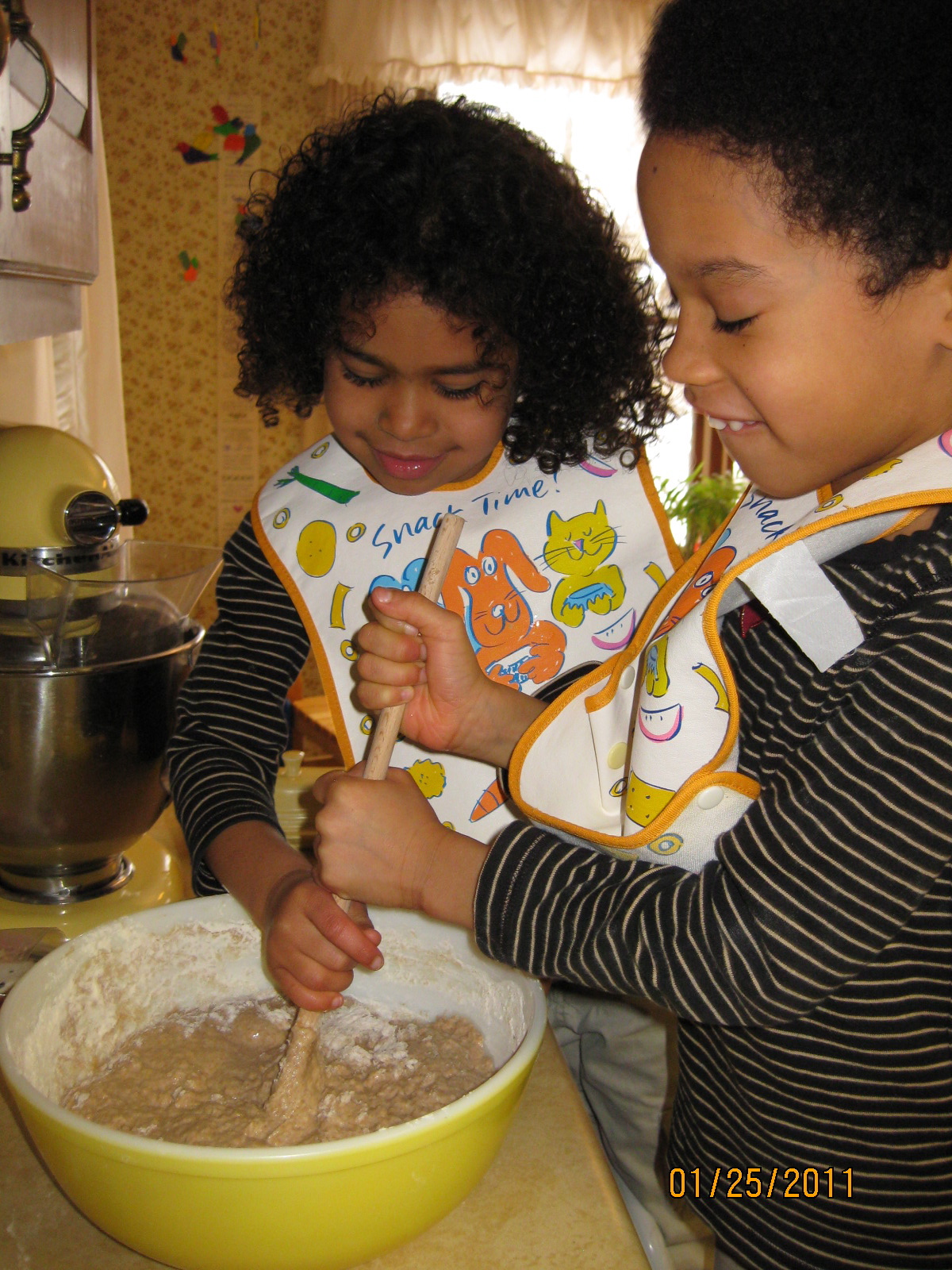
I have been baking almost all the bread my family eats for the past few years and have come to cherish this means of nourishing those I love. While I prepare multiple meals almost every day and bake a variety of sweets and treats, nothing I do in the kitchen is as fulfilling as this. Now that my girls can mix and knead along with me, the experience has become even richer.

I am drawn to bread baking not only as a caregiver, but also as an anthropologist. One of the simplest, most essential culinary activities utilized by humankind, bread making has been practiced in one form or another by nearly every human culture that has existed since grains were first domesticated over 10,000 years ago. Making homemade bread, then, connects us not only to our own ancestors but also to women and men throughout the world who have nurtured their families and communities with their own forms of "the staff of life."

I was once intimidated by the prospect of working with yeast. Since I didn't grow up baking yeast breads, I was often afraid of not getting the water exactly the right temperature, or of adding too much or too little flour during the kneading process. Not surprisingly, it took me a while (and many trials and errors) to figure out how to consistently produce a decent loaf. If I had to do it over again, I would jump in with a more confident, playful attitude, and ask for some tutoring from someone whose bread I enjoy.

Here I share recipes (or links to finding recipes) for our family's 3 favorite staple breads. The first of these recipes I formulated myself several years ago after my husband tasted a loaf of Amish bread while on a trip to upstate New York. The other two come from a couple of my favorite bread cookbooks.

AMISH-STYLE WHITE BREAD 
(Makes 2 loaves.) 
I modified the traditional formula for Amish white bread by using canola oil instead of shortening or lard. You could use either of those in this recipe if you prefer, though. Also feel free to adjust the amount of sugar. My husband joins the Amish in preferring his white bread a bit sweet, but I prefer it with less (or no) sugar. Play around with it to see what works for you. This is a soft, tender loaf and slices beautifully.

Ingredients:
2 cups warm water (110-115°)
2/3 cup white sugar
1 1/2 tablespoons active dry yeast
1 1/2 teaspoons salt
1/4 cup canola oil
6-6½ (5½  + ½-1) cups bread flour


Directions:
In a large bowl, dissolve the sugar in the warm water, and then stir in yeast. Allow to proof until the yeast resembles a creamy foam (about 5 minutes).
Add the oil to the yeast and sugar mixture. Mix in 5½ cups of flour, one cup at a time, adding the salt after several cups of flour are incorporated. Use the remaining ½-1 c. flour to knead the dough until smooth (10-12 minutes). Place in a well-oiled bowl, and turn the dough over to coat. Cover with a damp cloth and allow to rise until doubled in bulk, about 1 hour.
Punch the dough down. Knead briefly, and divide in half. Shape each half into a loaf and place each in a well-oiled 9x5 inch loaf pan. Allow to rise for 30-45 minutes, or until the dough has doubled in size.
About 15 minutes into the second rise, preheat the oven to 350°. Just before baking, place a broiling pan with a rack on the lower rack of the oven. Slash the loaves. After putting the loaves in, fill the broiling pan with 1 cup hot water. Bake for 30-35 minutes, until golden brown.


Jason's Whole Wheat Bread
(Makes 3 loaves.)
This is the bread that the girls and I have most enjoyed making together. It a kid-friendly bread in every way: it is both healthy and slightly sweet; it is not complicated to make; and once baked, it slices well for sandwiches. In fact, this recipe was written by a child. I found it in Recipes from the Old Mill: Baking with Whole Grains, a wonderful bread cookbook by written by two sisters (and available for purchase here). This is the story they tell of this recipe's origin: 
At 10 years of age, Jason, our nephew, began to bake bread. Since he has lived all his life next door to the old mill, it is not surprising that he chose to start with Whole Wheat Bread. He first went to the mill, got fresh ground whole wheat flour, and then made the bread for his brother's birthday dinner. What a wonderful gift of love and life!
Ingredients:
warm water
2 pkgs. dry yeast
1/2 cup honey
2 Tbsp. oil
1 Tbsp. salt
1/2 cup instant nonfat dry milk
4 cups whole wheat flour
4-4 1/2 cups flour


Directions:
1. Dissolve yeast in warm water.
2. Add honey, oil, salt, dry milk, and whole wheat flour. Mix well.
3. Add enough additional flour to make a stiff dough.
4. Knead 10 minutes until smooth and elastic.
5. Place in greased bowl, turning to grease top.
6. Cover and let rise until double, approximately 1 hour.
7. Punch down. Shape into three loaves. Place in greased 8" a 4" pans.
8. Cover and let rise until double, approximately 1 hour.
9. Bake at 375° for 30-40 minutes.


Whole Grain Artisan Loaf 
(Master Recipe)
This is my all-time favorite everyday bread recipe. It is the feature recipe in Healthy Bread in Five Minutes a Day, the second "Artisan Revolution" cookbook by Jeff Hertzberg and Zoë François. Refreshingly simple both in terms of ingredients and in method, it requires only flour (both white and whole wheat), yeast, salt and water [it also calls for vital wheat gluten, but I don't use it] , and it needs no kneading(!). You just mix up the dough, let it sit at room temperature a couple of hours, and then either form it into loaves or pop it in the refrigerator. 


Since it keeps well for at least a week, the baker can tear off and bake small batches of it whenever s/he needs a fresh loaf.  I usually bake our loaves in pans so it is easy to slice for sandwiches, but it also makes beautiful free-form loaves. In fact, it is an exceptionally versatile recipe and makes tasty pizza crusts, pita bread, crusty dinner rolls and cinnamon-raisin loaves. I made a bread wreath with it for the holidays and am planning to make cinnamon rolls for breakfast next weekend. 

Click here to learn more about Hertzberg and François' cookbooks and to find purchasing information. Or visit your local library to borrow a copy of the one you choose. 


Friday, January 13, 2012

Homeschooling on the Farm: A Typical Day

Conducting a Scientific Experiment in Our Backyard
Homeschooling is a difficult enterprise to describe. What it looks like for one family may be completely different from the practices of another. For people not familiar with homeschooling, the term often conjures up images of mothers in long skirts instructing their quiet, well-behaved children as they all sit around a kitchen table memorizing Bible verses and dutifully completing workbook exercises. Others understand it as little more than an excuse for parents to let their kids run wild and avoid the discipline and socialization that will turn them into responsible citizens of an orderly world. Neither of these stereotypes is accurate for most homeschooling families. Since several people have asked what homeschooling involves for my girls and me, I have decided to launch a series at this blog on "Homeschooling on the Farm," sharing what we do and why, and inviting a discussion about homeschooling and other models of alternative education. In this first post, I describe what a typical day of homeschooling (if there is such a thing) looks like for us.

Early Morning
On weekdays, my husband and I wake up around 4:30 and head downstairs to exercise. I'm sure it sounds absurd, but it's one of my most treasured times of the day. As I lift weights and work out on the treadmill and the recumbent bike, I get a chance to read books and magazines I wouldn't otherwise find time for, or listen to a podcast of a favorite NPR program I missed over the weekend. By 6:15, my husband has left for work and I am at the computer checking e-mail or trying to find more information on how to de-worm goats and chickens without chemicals, or which plants and herbs to combine in the same garden bed. Around this time, the girls wake up, make up their beds, get dressed, and come downstairs to report on the dreams they had or tell me a story they have been playing out in their room.

Feeding the Chickens Some Scratch
Then it's time to head to the barn. The girls generally get there first, dashing out the door as I yell--usually three seconds too late--"Don't forget your jackets!" They open up the barn and let the chickens out. Once I arrive, they help me toss some scratch to the chickens, take some hay to the goats, refill all the feed buckets, check the waterers, and then (last but unfortunately not least) muck out the coop and the goat stall--gathering up manure and freshening up the hay and wood chips. After dumping the contents of our muck buckets in the compost pile (it will make beautiful soil for our garden in the coming months), we return to the house for some breakfast.

As the girls eat their breakfast, I comb through their curls (and you thought mucking out the barn sounded challenging?!?) while reading to them from our current chapter book.*

Feeding the Goats Some Milk

After the girls finish eating, they usually head straight back out to the barn to check for eggs, visit with the animals, and orchestrate all sorts of dramas and adventures. These days they are spending a lot of time at the "houses" they have created from sticks, rocks, planks, and hay lying around the barnyard. While they hang out there, I prepare and eat my own breakfast, and then it's time to start school--or as we prefer to call it, "Discovery Time" (more on that in another post).

Mid-Morning
By this time it is around 9:00. While our daily study schedule is not set in stone (one of the advantages of homeschooling is being able to take advantage of opportunities that come up anytime, after all!), we follow a pretty consistent pattern. Two days a week, we begin our studies with a yoga session. For this, we follow a program called Angel Bear Yoga. It involves reflecting each time on a different principle or character trait (optimism, compassion, peace, love, patience, and so forth) and then acting out through yoga poses beings in nature that reflect that principle/trait (a sunrise, an elephant, a maple tree, a seahorse). On other weekdays, we begin by reading and memorizing poetry together.

Reading to a Favorite Doll
Then it is time for reading and writing. Each of the girls chooses from a group of readers I have selected for her based on her reading level and interests. They take turns reading, the older one often helping the younger one with several words. After that it is my turn to read to them. This is when we turn to our current unit studies topic. Our own unit studies system involves learning about different countries around the world: one each month of the school year. During that month, our social studies, science, and art appreciation studies focus on that country. Thus, the book(s) I read to them at this time will be about that country. Right now we are studying Australia (in the fall we covered Brazil, Japan, France, and Egypt).

After I read, they will carry out one or more hands-on activities related to that country. Examples include:
  • doing a related arts and crafts project (painting, making clay models, sewing)
  • studying the country's flag and coloring it
  • labeling and coloring a map of the country
  • listening and dancing to music from the country
  • preparing food from the country
  • conducting a science experiment related to the ecology of the country
  • watching an educational video about the country (generally short videos we access online)
  • completing interactive online activities related to the country.
Making Rainforest Animals from Clay
Painting in Impressionist Style while Studying France

The girls and I work together to choose their writing projects. We generally to try come up with an purposeful exercise (letters to friends) or something related to our unit studies theme (a mini-essay about dessert animals). This week they are writing and illustrating a fictional "book" about their goats and chickens called "The Case of the Missing Chicken Feed." After this we turn to math. We are currently using a combination of math exercises from the Oak Meadow homeschooling curriculum and a math program called Miquon Math. Both programs teach students (and their teachers!) to think creatively about math problems and to use manipulates to understand math concepts. Right now we are working on basic fractions. After math we might have music time, or we might have Spanish. At this point, we are generally through with our formal studies for the day. It is now around 12:30 and time for a short stroll up the lane or a visit to the barn and then lunch.
Doing Math with the Abacus
"Hop on the Answer" Math Game

The Rest of the Day/s
After we've all eaten and rested a while, we usually spend the afternoon doing some work on the farm: now mostly chores around the barn, but in the spring it will be gardening. Nature Study (often informed by the Oak Meadow curriculum) is a central part of many of our afternoons. If we are not doing work close to home, we might take a walk through the woods or go into town to visit the library, bake something, trek up to a nearby playground or a friend's house, or run errands. Sometimes we do research following up on topics we've breeched during Discovery Time or on topics the girls have come up with on their own. This week we have investigated--per the girls' requests--the reproductive system of rabbits, the life story of Mary Ingalls (Laura Ingalls Wilder's older sister), Louis Braille (inventor of the Braille writing system), Egyptian mummies, and lotus flowers.


Occasionally we go on a field trip. We might visit an art museum (this week it was the Mint Museum in Charlotte), a nature preserve, a farm, or a science center; or we might attend a theatrical performance, an educational program at a park, or a special exhibit (one of our favorites was the "Mummies of the World" exhibit at Discovery Place, also in Charlotte). I also enroll the girls in classes on a fairly regular basis (soccer, Spanish, nature studies, and gymnastics are among those they have taken).


So while we generally spend only a few hours of most weekdays doing what most people would recognize as "school," we spend a great deal of our time learning together--as we cook together, hike together, work together, and discuss books we are reading or issues that interest us. Perhaps the best laboratories we have for learning are the barn and the woods surrounding our house: as we observe the chickens for signs of sickness, follow the development of our young goats, watch the seasons change and the birds migrate, and organize seeds for spring planting, the girls and I delve into biology, chemistry, history, and sociology. And they learn some of the practical skills that have disappeared from the knowledge stores of so many American families and communities.

We call our little school "Whole World Homeschool"--an ambitious name for our tiny operation, perhaps, but reflective our our ambitions--to see the whole world as our classroom and our object of study: from India, Ecuador, the Alps and the Sahara to the earthworms in our backyard, the ferns in the forest, and the animals and plants we raise to feed ourselves.

And so we return to why homeschooling is so hard to describe. For us it is an adventure in learning that takes us well beyond the parameters of traditional "subjects" and well beyond the confines of classroom walls. It is an adventure that is often messy and difficult but also often filled with excitement, wonder and discovery. Perhaps most importantly, it is an adventure that allows us to journey together.

Eating Sushi for Japan Study
Making Feijoada for Brazil Study

Looking for Butterflies and Other Insects
___________________

*We have been reading chapter books together for several years now--since my younger daughter was 2 and her older sister 4. We have mostly read classics as well as a few more recently published novels. Among our favorites are The Little House Series, Anne of Green Gables, The Railway Children,  The Borrowers, Caddie Woodlawn, Blue Willow, Sarah Plain and Tall, The Little Princess, The Complete Tales of Winnie-the-Pooh, The Secret Garden, Black Beauty, The Wonderful Wizard of Oz, and The Sign of the Beaver. The girls greedily drink in these books, begging nearly every time I start to close a cover for "just one more page!" Honestly, though, I probably enjoy these sessions ever more than they do. It has given me a chance to read some great literature I missed during my own childhood. And a chance to share with my girls the joy and wonder of immersing oneself in worlds created by the imagination of others. It has also given me a greater appreciation of the capacities of children's minds to understand profound thoughts and complex stories. I have become convinced that we have done children a great disservice by "dumbing down" so much of the literature that is written for them these days. I believe we could do much better at helping children learn if we ourselves learned to show more respect for their intelligence and curiosity, and traded in our frequent dismissals of their capacities for a willingness to let their vibrant minds also educate our own.

Friday, January 6, 2012

Once Weaned, Twice Naughty

You know all those tales you've heard of goats being rambunctious and mischevious? Of getting into places they should not be and escaping from the places they are supposed to stay? Of nibbling on everything in sight, including items of clothing, the labels on tin cans, the hair on your head? Well, my girls and are here to set the record straight: It is all true!

If you have been reading this blog for a while, you know that in November our family brought to our farm three baby Nigerian Dwarf goats. We immediately feel in love with these furry, affectionate bundles of energy. For the next several weeks, we bottle fed them 2 or 3 times each day and spent quite a bit of extra time holding them and petting them. (My girls often talked with them, sang to them, and gave them math and reading lessons as well.) They ate up the attention, kissing our noses, dozing in our arms, climbing all over us like so many human jungle gyms, and wailing pitifully whenever we left them behind to return to the house.

They grew a great deal in November and December, and Tutu even got plump. Little did we know that they were also storing up great reserves of naughtiness. During the past couple of weeks--beginning suspiciously close to the time we weaned them from their milk--they started exhibiting all those classic goat behaviors we had heard so much about but were convinced (time for all you experienced farmers out there to chuckle) were grossly exaggerated. Most of their antics are simply comical, or at worst annoying (e.g., escaping from their stall into the main part of the barn every time we crack the door open). But some of them are maddening--especially their stubborn insistence on eating the chickens' feed.

Initially, Carolina, Tennessee Spot, and Tutu expressed little interest in the chickens, despite the chickens' frequent visit to their stall. ("The grass is always greener on the other side" is evidently one of the more predominant beliefs among barnyard animals.) But eventually they figured out that the chickens got fed, too(!), and they immediately made it their mission in life to raid the chicken feeder. So first thing every morning after they nibble at the fresh hay and concentrate we give them, they make a bee line for the other side of the barn. Though their noses can barely fit into the gap of the chicken feeder, they somehow manage to extract from it impressive quantities of crumbles. When they can't get enough to satisfy them, they knock it over. And if the chickens have the audacity to be having a meal of their own when the goats show up, the goats make short work of butting in, often chasing away the rightful diners in a flurry of squawks and feathers.

No problem, we thought. We'll just leave the feeder closed up inside the coop during the day, and the chickens can access it through their pop door. Of course, that was successful for all of 3 minutes, which is how long it took the goats to figure out where the feed had gone and squeeze through the pop door to get it. So I nailed a board over the opening of the pop door to make the opening smaller. That time it took about 5 minutes for them to discover they could still enter with ease. Two more boards later (the hole is about 6 inches tall and 4 inches wide at this point), and they're still helping themselves to all the chicken feed they can eat.
My husband is going to the feed store today to see if he can get a chick feeder (with smaller holes than a regular feeder) and then try to bolt it down securely enough that they can't flip it over. I wish I were more optimistic about the chances of Plan C being successful.

You might ask: What's the big deal? So what if the goats eat some chicken feed? I spent a week or so trying to comfort myself with that very thought. But it turns out chicken feed is actually quite bad for goats, at least in significant quantities (it is much too high in protein and can harm their ruminant stomachs). Goat food isn't great for chickens either. (I'm afraid the chickens have gotten a good bit of revenge by their own raiding in the goat stall.)

We are determined to make our little farm as integrated and natural as possible, and to give our critters the chance to spend most of their lives outside of stalls and pens. But this free-ranging thing turns out to be a bit more complicated than we expected, full of unexpected challenges and quirky crises. In fact, it reminds me a whole of trying to parent. And while that adventure is the toughest I've ever faced, it has also been the most rewarding. That gives me the courage to stay hopeful (and reminds me to keep a sense of humor!) as we stumble and trip our way through this new adventure. But right now, I've got some naughty little kids I've got to go feed.

Sunday, January 1, 2012

Simple Pleasures: New Year Reflections

"I believe the nicest and sweetest days are not those on which anything very splendid or wonderful or exciting happens but just those that bring simple little pleasures, following one another softly, like pearls slipping off a string." --Anne Shirley, in Anne of Avonlea by L.M. Montgomery

As I look back over the past year and ponder the many gifts it has brought my family and me, I find myself feeling most grateful for some of the simplest ones. I thought I would share a few of those with you--and invite you to come up with a list of your own, and to share it with those you love.

Memories of Simple Pleasures from 2011:

  • Watching my two daughters play for hours in the creek bed--building castles, wading, catching crawdads, and pretending to be fish swimming in the Nile
  • Looking up to see Carolina Blue skies during a lazy summer-afternoon stroll
  • Taking in the smell of alfalfa and pine chips when I open the barn door in the morning
  • Successfully(!) rigging up the hammock in the wooded grove between our yard and the lower pasture, and then watching the girls enjoy endless hours swinging in it
  • Sitting quietly in the pasture with the chickens, watching them forage and listening to them sing and chat
  • Realizing in the middle of a hard day that there is a book I can't wait to keep reading waiting for me on my bedside table
  • Mixing and kneading bread with the girls--and walking in the door a couple of hours later after a quick trip to the barn to the smell the loaves baking in the oven
  • Satisfying the bleats of baby goats with the milk that will help them grow strong
  • Feeling one of those goats fall asleep in my arms just after she has finished her bottle
  • Feeling her a few minutes later hopping onto my back and nibbling at my hair
  • Walking in from finishing the chores on a cold winter morning and smelling the coffee my husband has just brewed
  • Feeling the warm cheeks and wet lips of my daughters as they reach up from their beds to kiss me goodnight
  • Biting into an apple that was seconds ago still part of a living tree
  • Enjoying the company of new friends
  • Finding our farm's first egg
  • Learning together with my girls about countless new topics
  • Watching them slowly figure out how to read and solve math problems on their own
  • Hearing the crunch of fall leaves underneath our feet as the girls and I hike through the woods near our house
  • Sitting down to watch a movie with my husband on the comfy couch in the den on Friday evening, knowing that tomorrow we have nothing in particular on our schedule
  • Planning the garden we will plant in the spring.

For all these things and for so many more I am grateful--not only for the ways they have already blessed my life, but also for the hope they give me--hope that no matter what happens in this new year, no matter what difficulties arise, life will continue to brim over with everyday sweetnesses.

Let us resolve take the time to see, hear and feel the simple pleasures of 2012.

"Earth's crammed with heaven, and every common bush afire with God. But only he who sees takes off his shoes . . ." --Elizabeth Barrett Browning

Tuesday, December 27, 2011

Holiday Baking

For many of us, the holiday season means extra baking and extra sharing of homemade treats. I thought I would share here the recipes for some of the treats I made for friends and family this year. I hope you enjoy trying out the ones that look good to you. Let me know if you have some of your own recipes you think I should try!

Jennie's Pecan Pie

I started developing this recipe soon after my husband and I began seeing each other. We were chatting one afternoon when I thought to ask him what his favorite dessert was. He immediately responded, "pecan pie." He pronounced it wrong, of course, saying "pee-can" instead of "puh-cahn," but that's not the really scary part of this story. That came next, when I asked him, "Who's been making pecan pies for you?" and he answered "Mrs. Smith." Before I could stop myself, I blurted out, "You've been BUYING pecan pies? From the GROCERY STORE?" My shock and dismay must have been apparent, as he timidly responded "Uh . . . yes." "Then you've never tasted pecan pie!" I exclaimed, now clicking fully into sassy Southern woman mode. "I'll fix that," I continued as I grabbed my coat and headed home to look for recipes. I had never actually baked a pecan pie myself at that point, but that didn't deter me. I knew the basics of what to do from watching my mom make many of them over the years. And, for better or for worse, I had inherited a bit of both her prowess and her confidence in the kitchen. So I was pretty confident that I could come up with something better than the stuff from the deep freeze at the Piggly Wiggly. I'm pretty sure my first one wasn't that great. (He seemed to think it was, and at the time, that's all that mattered.) But over the years of making them regularly, I've tinkered around and come up with a formula that seems to work well. I hope you'll agree.

Recipe for Jennie's Pecan Pie
Position a rack in the center of the oven and preheat to 350°.

Prepare the dough for a 10-inch piecrust. Roll it out and place in the pie plate. Set the plate in the refrigerator.

Spread on a baking sheet 2 cups pecan halves (or a little more if you’re feeding real pecan lovers). Toast the pecans for 5-7 minutes, stirring occasionally, until golden and fragrant. Set aside to cool.

Whisk until blended:
 5 T. unsalted butter, melted and cooled slightly
½ c. white sugar
 ½ c. firmly packed brown sugar
 ½ t. salt
½ c. dark corn syrup
 ½ c. light corn syrup 3 large eggs
1 t. vanilla
2 t. dark rum

Stir in the toasted nuts. Remove the pie crust from the refrigerator and pour in the filling. Bake 40-45 minutes, or until the edges are firm and the center seems set (it may still be a bit quivery). Let cool on a rack for at least 1½ hours. Serve at room temperature or toast individual slices and top with whipped cream or ice cream.

By the way, this pie freezes very well! (I wrap the slices individually in plastic wrap and then place them in a plastic bag before putting them in the freezer. Whenever my husband wants a slice, I take one out, quickly thaw it in the microwave, and then pop it in the toaster oven.)

Chocolate Velvet Cake with Coconut-Pecan Frosting

This cake is both delicious and visually impressive. A virtual tower of indulgence, it resembles German Chocolate Cake, but the cake itself has a nicer texture and the layers are thicker than a tradition German Chocolate. Here is  the recipe from Southern Living Magazine. (I had to make 1 1/2 the recipe for the frosting in order to have enough to cover the cake generously.)

Cookies for Santa: Ma's Best Butter Cookies

This recipe is truly an old-fashioned one, and a great one to make with your kids. It is Laura Ingalls Wilder's version of her mother's butter cookies, rewritten for her youngest fans. It comes from the collection My Little House Cookbook (HarperCollinsPublishers).

As you can see from the photo above, the girls and I rolled out the dough and cut it with cookie cutters instead of following steps 5 and 6 below. The dough rolled and cut well. As you can also see, we decorated them pretty simply. (The girls enjoyed shaking the colored sugar over the cookies with abandon much more than trying to make precise designs!)

Recipe for Ma's Best Butter Cookies
(Makes about 25 cookies)
Ingredients
1 1/2 cups flour
1/2 teaspoon salt
1/2 teaspoon baking soda
1/2 teaspoon powdered ginger
1 stick unsalted butter, room temperature
1/2 cup light brown sugar
1 egg
1 teaspoon vanilla
2 tablespoons sugar* or colored sprinkles

Directions
1. Ask a grownup to help you preheat the oven to 375°.
2. Put the flour, salt, baking soda and ginger into a small bowl and mix lightly.
3. Use a sturdy tablespoon or a large wooden spoon to cream the butter and sugar: First mash the softened butter thoroughly in a large bowl. Next, add the brown sugar and mash the butter and sugar together until they are soft and completely combined.
4. Add the egg and vanilla to the butter and sugar and mix together well. Empty the bowl of dry ingredients into the wet mixture. Keep stirring until thoroughly combined. Finish off with your hands if you'd like, mixing until the dough is one uniform light-brown color.
 5. Pour out the 2 tablespoons of sugar into the bowl that held the flour mixture. Wash your hands and don't dry them. Roll walnut-sized balls of dough. 
6. Press one side [of each ball] into the sugar or sprinkles, coating the top generously. Place the balls, topping side up, 1 1/2 inches apart, on the cookie sheet. Press the fork into the cookie.
7. Bake for 12 minutes or until cookies are lightly browned. Remove with the spatula and place on a rack to cool. Store in an airtight tin.

*We like to color the sugar ourselves--it's very easy and much less expensive than the store-bought versions. Just add a few drops of food coloring to a small bowl of sugar and stir thoroughly. Keep adding food coloring until the sugar is the desired hue.

Favorite Old-Fashioned Gingerbread

This is a dense, dark, intense gingerbread. The recipe comes from www.allrecipes.com. A topping of slightly sweetened whipped cream seems the compliment it just right.


Thursday, December 22, 2011

Our First Egg!

It finally happened! Queenie, the elder among our young chickens, laid her first egg. The girls had told me earlier in the day that they thought she was trying to lay--that she was sitting quietly in a corner of the coop and would peck at anyone who got too close. But we were all afraid to get our hopes up. And then there it was! Beautiful. Perfect. Light brown with the tiniest whitish speckles. An impressive specimen for a first-time layer. A small, everyday, awe-inspiring miracle.
Quennie's proud caregivers
Queenie leads the pack in more ways than one!

Tuesday, December 20, 2011

Feeling It: Getting Back in Touch with the Weather

Sunshine is delicious, rain is refreshing, wind braces us up, snow is exhilarating; there is really no such thing as bad weather, only different kinds of good weather.  --John Ruskin

Some of the best gifts of the new life we are leading have been the least expected ones. One of those surprise gifts is the chance--no, the obligation--to become intimately familiar with the weather. Doing daily farm chores means being out in the weather--pleasant weather, miserable weather, calm weather, turbulent weather--at least twice a day every day. Although I have always made a point of "getting some fresh air" for at least a little while every day, until recently I have been able to pick and choose exactly when and how extensive such breaths might be. Not so now that I have chickens and goats that must be cared for each and every morning and evening. So I find myself going out at times I would otherwise choose to stay inside, hovering over a first cup of coffee or taking a relaxing end-of-the-day shower.

And it has been a gift: to know that it is cold, not because I saw the forecast or because I got a little chilled dashing in and out of the car, but because my fingers are too stiff to hold the muck bucket without dropping it on the way back to the house. To feel the grace in the touch of the sun gently warming the icy air. To absorb the wetness of the dew and the rain, and then to carry it around in the mud on my boots. To see the miniscule but dramatic changes in the plant life around me as the each of the seasons emerges, matures, and fades into another. Being more in touch with the weather and the natural world, I have found, makes me feel more alive. Perhaps that's partly because it makes me feel more connected to other living things. And a little less hooked up to the gadgets and the bells and whistles that make up so much of daily life in the modern world.

There are only two other periods in my life when I have been intimately familiar with the weather. The first was during early childhood. My sisters (and later my brother) and I spent a great deal of our first years in this world out in the world--hiking in the woods that surrounded our home,  swinging from vines, wading in streams, playing various kinds of "ball," pretending to be cowboys and Indians and cops and robbers, and even doing a bit of gardening with my dad. Our own opinion about the weather seems to have been been very like Christopher Robin's: we didn't much mind what the weather did as long as we got to be out in it. In fact, I don't remember ever minding the cold, the rain, or the heat. But I do remember minding getting called inside for dinner (to be truthful, that probably only lasted until I caught the scent of my mother's fried chicken or blackberry cobbler waiting there for us).  Looking back, I now realize that most of my fondest childhood memories are set outside.

The other time in my life when I have lived much of my days "out in the elements" was during the several years I spent in rural Haiti as a young adult. Dwelling in a mud hat far away from paved roads, electricity, and other forms of urban development, I came to cherish being more in touch with the cycles of nature than I had ever been. There nearly everyone spends the majority of their waking hours outdoors. In fact, the center of the household in rural Haiti is not the living room or the den, but the lakou, the yard. It is in this simple packed-dirt space, often surrounded by fruit- or coffee trees, that people carry out most of their daily chores and do most of their visiting. It is there that children are raised and elderly parents are cared for. It is there that feuds erupt and get settled. While living in rural Haiti, then, I never had to look on a calendar to know what phase the moon was in; I knew it because I lived under it, because it impacted my daily life. Just as I knew how wet or dry the land was, how long the last heat wave had lasted, or how strong the winds of the latest storm had been. Upon returning to the U.S., I found myself often feeling disconnected and "boxed in." I marveled at the fact that most of us spend most of our time in boxes. We sleep and eat in a big one, and then go out and get in small mobile one, which takes us to another one larger than the first to spend most of the rest of the working day, and then perhaps to a few huge ones to shop afterwards before bringing us back home to the box we left in the morning. It all felt so claustrophobic and isolating to me during my first few weeks back home. But of course, I quickly got used to it. And I soon forgot to wonder about whether the moon was new or waning, or whether spring had finally given way to summer, or how much rainfall we had had the night before.

Farming has given me the chance (the push) to leave my boxes behind a little more often and for a little bit longer than I have most days of my life. And what an invigorating and liberating--if sometimes uncomfortable and messy--gift it has been.

      "Noise," by Pooh (or rather, by A.A. Milne)

      Oh, the butterflies are flying,
      Now the winter days are dying,
      And the primroses are trying
      To be seen.
      And the turtle-doves are cooing,
      And the woods are up and doing,
      For the violets are blue-ing
      In the green.

      Oh, the honey-bees are gumming
      On their little wings, and humming
      That the summer, which is coming,
      Will be fun.
      And the cows are almost cooing,
      And the turtle-doves are mooing,
      Which is why a Pooh is poohing
      In the sun.

      For the spring is really springing;
      You can see a skylark singing,
      And the blue-bells, which are ringing,
      Can be heard.
      And the cuckoo isn't cooing,
      But he's cucking and he's ooing,
      And a Pooh is simply poohing
      Like a bird.