Wednesday, May 2, 2012

Feelin' Broody


In all the months we had a rooster here at the farm dutifully making his rounds among the hens, none of our hens showed any interest in sitting on eggs. Since we thought it would be both fun and educational to watch the laying-hatching-mothering-growing cycle, we did our best to encourage them to "go broody." We'd place several eggs together in one nesting box and leave them there for a couple of days. When that didn't work, we'd start a new clutch in another box. When that went nowhere, we'd do the same thing in the barn--setting clutches of eggs in corners and on haystacks. We also tried feeding, watering, and petting the hens while they were laying. We got no response at all, except an occasional "oh-you-silly-humans-always-trying-to-control-things" look. We continued this little charade off and on for weeks, right up until the day Captain Haddock left this world behind (see the 3/26/12 post to read about that harrowing drama). There was no point in continuing on after that, of course, since the eggs would no longer be fertilized. (Did you know that chickens lay eggs even without a rooster around? A lot of folks don't. For more interesting--and sometimes surprising--facts about chickens and their eggs, check out this page at BackyardChickens.com.)

Now, less than a month after Captain's departure, one of our hens has decided to go broody! Crystal, the Splash Jersey Giant belonging to my younger daughter, Simi, is determined to sit on eggs. At first we thought she was just "playing house," but as 2 days turned into 3 and then 4, and she was still sitting there, we realized she was serious. The girls tried convincing her to get out of the nesting box, explaining in the gentlest and most sensitive of terms that she'd get no chicks out of those eggs. She was unimpressed with this argument. So my husband, G-P, decided to take them all away--snatching them out from under her one evening when he came home from work (he still has the peck marks to show for it). I was sure that once she realized she wasn't sitting on anything but straw, she would lose interest. But no. She was bound and determined to stay right there. It started to get sad. Seriously, it was breaking my heart seeing her sit there hour after hour, day after day, going without food and drink, patiently waiting for her non-existent little ones to develop.

I know I really shouldn't anthropomorphize. And I know that if we'd tried a bit harder, we could have "broken" her of the broodiness, and she'd probably have quickly forgotten about the whole ordeal. (If you ever find yourself in a similar situation and need information on how to do this humanely and effectively, consult this forum, again at BackyardChickens.com). But we just couldn't bear to do that. So one evening, we called our good friend and organic supply store owner T. McLeod, and he offered to bring a dozen fertilized eggs to his store the next morning. G-P ran out to pick them up and put 8 of them in Crystal's box. He said it was amazing to watch her "take them in," gently pushing each one underneath herself to just the right spot.

And she's been sitting there quietly ever since, the epitome of the long-suffering, selfless mother. Although the girls offer her handfuls of scratch and sips of water every morning and evening, she eats and drinks very little. Neither does she seem to sleep very much. Every time I've been to the coop since she started brooding, she has been completely alert. In fact, she has taken to possessively guarding her nest, "growling" (as the girls describe it) at anyone tempted to get too close and pecking those who do.  She has also started plucking feathers from her breast with her beak to insulate and soften up her nest for her babies. She will continue all this for 21 days--the typical incubation time for chicks.* Then she will have another overwhelming job ahead of her: feeding, grooming, safeguarding and educating 8 little ones!

More than likely, she won't complain a single time. She won't play the martyr. She won't dramatize the depravations. She'll simply give her best shot at doing what needs to be done to take care of her offspring. I plan to spend part of Mother's Day this year out in the coop with Crystal. I have a feeling there are some things I can learn from her.

Mother Hen
(accessed at orbadvisor.livejournal.com
I am having one of those days
where I want to take you under my wings
and nestle you against my bosom,
keeping you warm against the winter air
and safe from the salivating wolves that surround us
I may freeze from the cold--
they may have to pry your peeping bodies
from beneath my ice-covered wings--
or I may be eaten by society's wolves--
they may have to search through my entrails
to discover the still-living chicks--
but I want to keep you safe. I will keep you safe.
Come to me, my children. There, there.

* All of Crystal's behaviors are typical of brooding chickens. For a detailed description of the behavior of broody hens, click here

Monday, April 23, 2012

Tough Love in the Garden

The miracle of the seed and the soil is not available by affirmation; it is only available by labor.  
~Jim Rohn

It is utterly forbidden to be half-hearted about gardening.  You have got to love your garden whether you like it or not. 
~W.C. Sellar & R.J. Yeatman, Garden Rubbish, 1936


On April 10 around sunset,  I walked out of the garden, secured the fence, and turned around to take one final look. I sighed with relief as I took in the 20 lovely (if not entirely straight or level) planting beds surrounded by hay-covered walking paths. I was exhausted. Beat. Sore. And I hadn't yet planted a single thing.


Just a few weeks after getting settled into our new home last fall, I began working on converting the largest bit of yard on our property into a garden plot. First, I cut and laid over the grass the cardboard boxes that had carried our stuff here from Ohio. Then I asked our neighbor, Tom, to bring in some composted cow manure to put on top of it, and finally, sowed winter rye seeds in the compost to provide a nitrogen-fixing, weed-inhibiting cover crop. Then I let it sit . . . and sit . . . and sit.  As the rye took root, the cardboard decomposed, and the earthworms munched, I perused seed catalogs and dreamed of eating homegrown tomatoes and bush beans.


This February I began to do the real work of preparing the plot for planting. It turned out to be harder than I thought to till the rye, compost and cardboard into the clay soil that lay beneath it. I started out using only my mattock, and had worked about a third of the way through the 1250 square-foot plot by the time my husband, G-P, came out to lecture me on the silliness of rejecting modern conveniences and to insist that we put to work the motorized tiller my twin sister had loaned us. So we finished the plot in style--and boy, was it easier! Little did I know that I had just gotten started.


Gardening is a matter of your enthusiasm holding up until your back gets used to it.   
~Author Unknown

I soon realized that the tiller had just barely scraped the surface of the clay, and that I therefore needed to dig a good bit deeper. So we called Tom again, and one afternoon while the girls and I were at the library, he brought over his tractor and plowed it up. Once again, I'd assumed that this would do the trick. But when we got back, I saw that the plowing had left behind a plethora of small, large and HUGE clumps of clay soil--many of them as hard as rocks. Seriously--they were as hard as rocks. I know all you native North Carolinians out there are laughing. But I was stunned. And beginning to get discouraged.

Back I went, mattock in hand again. It took me another several afternoons of work to get the large clumps and huge clumps broken into smaller clumps and to smooth everything out to some resemblance of level. But it still didn't look anything close to arable.


So we ordered 8 more yards of compost. They hauled it in on a Sunday afternoon. After another week of labor (and some help from G-P and the girls), I had the compost spread and worked in. Thankfully, G-P was kind enough to take charge of deciphering and installing the portable electric fence we'd ordered. After it was in place, the girls and I spent several hours measuring and demarcating the 20 planting beds. (I decided not to make framed raised beds but rather informal ones that I could later shift if I needed to--which, of course, didn't stop G-P from pointing out that gardeners back in Nigeria never measure their beds at all, and the plants grow just fine.) A couple more of afternoons of raking and spreading hay, and they were all ready. It was done. I was finally ready to plant.


If all this sounds as ridiculous to you as it sometimes seemed to me, you might consider this fact--endlessly repeated in nearly all the literature on organic gardening: soil preparation is the most important step to creating a healthy, productive garden.  As Marion Cran put it, "If I want to have a happy garden, I must ally myself with my soil; study and help it to the utmost, untiringly. Always, the soil must come first." Rich organic soil attracts beneficial insects and discourages pests; provides long-term nourishment without the need for expensive (and potentially harmful) fertilizers; and produces vegetables and herbs with higher levels of vitamins and minerals than conventional, chemical-infused farming. (I have to admit that keeping all this in mind was about the only thing that got me through a few of those afternoons.)

After all the soil prep, planting has seemed like a stroll in the park! So far the girls and I have put in (as transplants we grew indoors, or as seeds):
Lettuce
Spinach
Carrots
Tomatoes
Cabbage
Broccoli
Onions
Leeks
Zucchini
Bell peppers
Bush beans
Sunflowers
Oregano
Parsley
Thyme
Rosemary
Asparagus
Basil

 Soon to follow in their footsteps will:
Habanero peppers
Bush beans
Cayenne peppers
Pole beans
Cucumbers
Chamomile
Celery
Several different kinds of flowers

In parenting, I have come to think of true "tough love" not as a kind of love that is hard on the child, but the kind of love that challenges the parent to reach deep inside herself and find those reserves of strength and patience that will allow her to accept and nurture instead of spurn and demean. It is often very tough indeed. And humbling. Perhaps loving our gardens is also an adventure in tough love; goodness knows it is humbling. But (again, like parenting) it is beautifully--and often surprisingly--rewarding, too. Even though the only fruit of our labor we've enjoyed so far is seeing the broccoli plants gain a half-inch in height and the first bits of green poke their heads out of the spinach and lettuce beds, it has already been worth all the work. That's how it is with labors of love.

Monday, April 16, 2012

Summer Camp at Little Bent Creek Farm

Would you like your children to get a chance to feed goats and hens? Collect eggs? Watch young chicks grow? Clean out stalls? Work in a garden? Play in a creek? Taste bread and butter they've made themselves? If so, then consider sending them to our Little Bent Creek Farm Camp this summer. Sponsored by Woodland Discovery and led by professional child educator and camp director Carolyn Walker (see my April 5, 2012 post for more information on Carolyn), the camp will be held from June 11-15 here at Little Bent Creek Farm in Davidson. It is a morning camp and is targeted at 4-10 year olds. You can find more information (on this and other Woodland Discovery camps) as well as registration forms here.


Come out and let us show your kids just how fun farm work can be!

Wednesday, April 11, 2012

Eggs for Sale!


We finally have enough eggs to offer 2-3 dozen a week for sale. (We hope we'll have many more by this time next year, when the chicks we're expecting in May will be laying.) They are all brown but vary in shade and size. We are selling them for $3/dozen.

Here's a bit of information about the hens who lay our eggs: They all belong to heritage breeds, some of which populated our country's very first small homesteads. They spend most of their days free-ranging throughout our organically run farm (we don't use any herbicides or pesticides--ever). Their diets are supplemented by organic scratch and organic layer feed, both purchased locally. All this means that their eggs are significantly higher in folic acid, protein and Omega-3s than most grocery-store eggs. We have never medicated our chickens for anything, so their eggs don't contain any traces of antibiotics or other icky stuff.

So here's your chance to taste some happy-, healthy-, hippie-hen eggs! If you live somewhere in our vicinity and would like us to hold a dozen (or a half-dozen) for you, just let me know (at littlebentcreekfarm@gmail.com).

Thursday, April 5, 2012

Healing Our Children, Healing the Earth: Carolyn Walker

There was a time when meadow, grove, and stream,
The earth, and every common sight,
To me did seem
Apparell'd in celestial light,
The glory and the freshness of a dream.
--from "Intimations of Immortality from Recollections of Early Childhood," 
by William Wordsworth

There is a childhood epidemic sweeping our country today, infecting millions of our young people and compromising their prospects for the future and the future of the planet itself. It may already be too widespread to stop altogether, but there is reason to hope. For all across the nation, there are increasing numbers of valiant women and men who have committed themselves challenging this threat. The malady is called Nature Deficit Disorder, and one of its heroic enemies lives right here in our community: Carolyn Walker. Founder and director of Woodland Discovery, Carolyn works tirelessly to provide opportunities for children (and often their also-deficient parents) to get outdoors, to learn about the natural world, and to come to love and protect it.

For this second installment in the Sustainability Heroes Series*, I sat down with Carolyn Walker to talk about her work and what energizes her.

LBCF:  What led you to start Woodland Discovery?
Carolyn:  When I finished my education, I was planning on teaching high school business, since that is what I had been trained to do. But after five children, I realized that I really loved working with preschoolers. Around that time, I read somewhere the quotation, "As the twig is bent, so the tree inclines," and I realized that the best way to make an impact on someone's life is to influence them early.

So instead, I began teaching preschool. I spent many years doing that. I loved it; I loved working with the children there. But I kept seeing these kids come in who didn't want to go outside, didn't want to touch dirt, were afraid to try to climb a tree. I was also seeing preschool education becoming more and more academic--placing more emphasis on math and reading (often way too early) and devoting less and less time to play.

I saw parents accepting all this because they were afraid that if they didn't, their children would fall behind. They didn't realize that free play in nature is probably the best foundation for academic success. They didn't realize that the best way to keep kids safe in the long run is not to ban them from climbing trees or wading in water, but to teach them how to decide which risks to take so that they can learn to keep themselves safe without our intervention. I always told my own children and my preschoolers, "Sure, go ahead and climb the tree. But don't climb any higher than you want to fall." Then I would move closer to talk them through the process or catch the occasional misstep.

I actually just learned that insurance companies in Germany are starting to encourage schools to create more dangerous playgrounds. They report that they are tired of paying claims for so many adults who do not have any balance or "risk sense." What studies are beginning to show is that nature play has measurable positive outcomes in physical, mental, emotional, and cognitive ways--for both children and adults.

LBCF:  So what finally led you to start up this business?
Carolyn:  It's a long story. I was at a turning point in my career. I needed more autonomy in my work to do what was best for children, rather than cater to adults. And I wanted to do something that I felt passionate about. I had just finished reading Richard Louv's book (Last Child in the Woods: Saving our Children from Nature-Deficit Disorder**). I love children; I love being outdoors; I love to be creative; and I love to play. It all fit! And it would fulfill a unique need in our community. I thought that perhaps I could help parents get their children back into the woods. I realized that if they didn't have the time or the resources or a safe environment to let their kids play in nature, I could do that for them.

I spoke with some parents about it, and a lot of them said, "If you get something going, we'll send our kids to you." I first thought about starting a school, but the land purchase didn't work out. So then I decided that maybe I could make Woodland Discovery a mobile thing. I started offering classes at parks and on others' properties--moving from place to place as needed.

[Woodland Discovery now offers classes and camps year-round. My own daughters took a 6-week nature class with "Ms. Carolyn" last fall and had a wonderful experience. You can find their Woodland Discovery's 2012 summer camp schedule at http://www.woodlanddiscovery.org/summer-camp.]

LBCF:  Do you have a 5- or 10-year vision for how Woodland Discovery might look in the future?
Carolyn:  It would be wonderful if we could acquire some land of our own. This would allow me to do so much more than I am able to do right now. Before I even thought of providing nature studies, for instance, I thought a lot about playgrounds and how sterile and removed from nature most of them are. I think it would be great if we could have a "natural playground" with real stumps and trees that the kids could climb. We could have a children's garden and an outdoor classroom. It could be a prototype outdoor learning center, where teachers could come for ideas and then work on replicating similar playing and learning spaces where they work.

[Woodland Discovery is looking for a benefactor who could help them purchase a modest property on which to build such a playground and as a base site for their classes and camps.]

LCBF:  You are also on the board of World of Wonder (WOW), a collaboration with Davidson Lands Conservancy (DLC). Can you tell us a little bit about that group as well?
Carolyn:  WOW was the brainchild of Pam Dykstra, President of DLC, who realized that if we wanted people to become committed to conserving land, we needed to help the next generation value it. My contribution was to brainstorm activities that would be family/kid-friendly. So WOW was set up to provide nature education opportunities for children and their families. Our two main methods of educating these groups are through the booth we have at the Davidson Farmer's Market and the nature-education excursions we sponsor (all of which welcome children). We couldn't do any of this without dedicated committee members and volunteers. WOW has been wildly successful--so successful that I think we may see it replicated in other communities. Wouldn't that be wonderful?

[To find more information on these activities and a schedule of upcoming events, visit http://www.davidsonlands.org/category/worldofwonder/, or sign up for the weekly WOW e-mail by writing to dlc.wow@gmail.com.]

________________________

Mother Teresa of Calcutta once said, 
What I do you cannot do; but what you do, I cannot do. The needs are great, and none of us, including me, ever do great things. But we can all do small things with great love and together we can do something wonderful.
Not many of us could do the work that Carolyn Walker is doing. It is time-consuming, intellectually and socially demanding, frequently messy, and often unnoticed. Yet she--and all the good folks who work with her--are doing something truly wonderful. They are offering to our children and our earth a brighter, healthier future. It is hard to imagine more worthwhile work than that.

This interview series is meant to celebrate people in and around west-central North Carolina who are making valiant efforts to live sustainably and to help others on their own sustainable living journeys. It is my hope that these interviews will be a source of information and inspiration to the readers of this blog.

**If you would like to learn more about Richard Louv's book, Last Child in the Woods, or to become involved in the Child and Nature Network that was established to respond to the challenges presented in the book, visit http://www.childrenandnature.org/.

Wednesday, March 28, 2012

New Babies

Snowdrop and Daisy--our two new Saanen-Alpine crosses

'Tis the season for babies! The woods around our little farm are bustling with activity, as the birds, bugs, squirrels and deer begin welcoming wee ones into the world and nurturing them toward adulthood. We also have been gearing up for new members of our barnyard family.  In the past few days, we have placed an order for 26 baby chicks (to arrive in April) and brought home three baby goats.

This time we decided to purchase full-size dairy goats to add to the three Nigerian Dwarfs that have been with us in November. We were lucky to have the opportunity to do our goat shopping at Maple Lane Homestead, a beautiful farm in Concord, NC where Kelly Foster, her mother, and her husband raise dozens of goats and sheep, chickens, turkeys, bees, and a huge garden of lush vegetables and herbs. (You can read Kelly's farm blog here.) Based on the research I had done and Kelly's experience-rich advice, we chose two Saanen-Alpine crosses and one purebred Alpine. Whereas Nigerian Dwarfs offer smaller amounts of milk that is very high in butterfat (and therefore perfect for making cheeses, soaps, and of course, butter), Saanens and Alpines are higher-quantity producers (the two "champion milkers" of the dairy goat world) and provide lower-fat milk--ideal for drinking and making yogurt.

Ezili, the Alpine, tries to suck some milk out of my finger.

We adore these new little ones. They are sweet, gentle, frisky, and a bit shy. But not actually very little.  We were stunned when we went to pick them up to find that two of them had already grown taller than our 6-month-old Nigerians! The good news is that these new whipper-snappers were trained on the bottle before we brought them home, so bottle feeding has been a breeze this time around in comparison to our first try (a recorded in my November 23, 2011 post).

The Nigerians are predictably jealous--bawling piteously as we bottle feed their new compatriots in the stall next door, kicking the walls, and threatening to run away and never come back. Unfortunately, they have also been picking on the new kids quite a bit. We're trying to be patient with our bullies, thinking things will calm down once they re-establish the hierarchy of the herd, or--if not--once the newbies are towering over them in a few weeks!

My daughters, Segi and Simi, have adopted the two Saanen crosses, and I've been allowed the privilege of mothering the Alpine. She's the scrawniest one of the lot, and thus the most harassed. I'm hoping she'll learn to stick up for herself soon. In the meantime, we'll be relishing the pleasures of nurturing our new babies and dreaming of the milk they will hopefully be giving us in return during the years to come.

Monday, March 26, 2012

Oh, Captain! Bye, Captain!

There are some graphic photos in this post. Please view with discretion. 

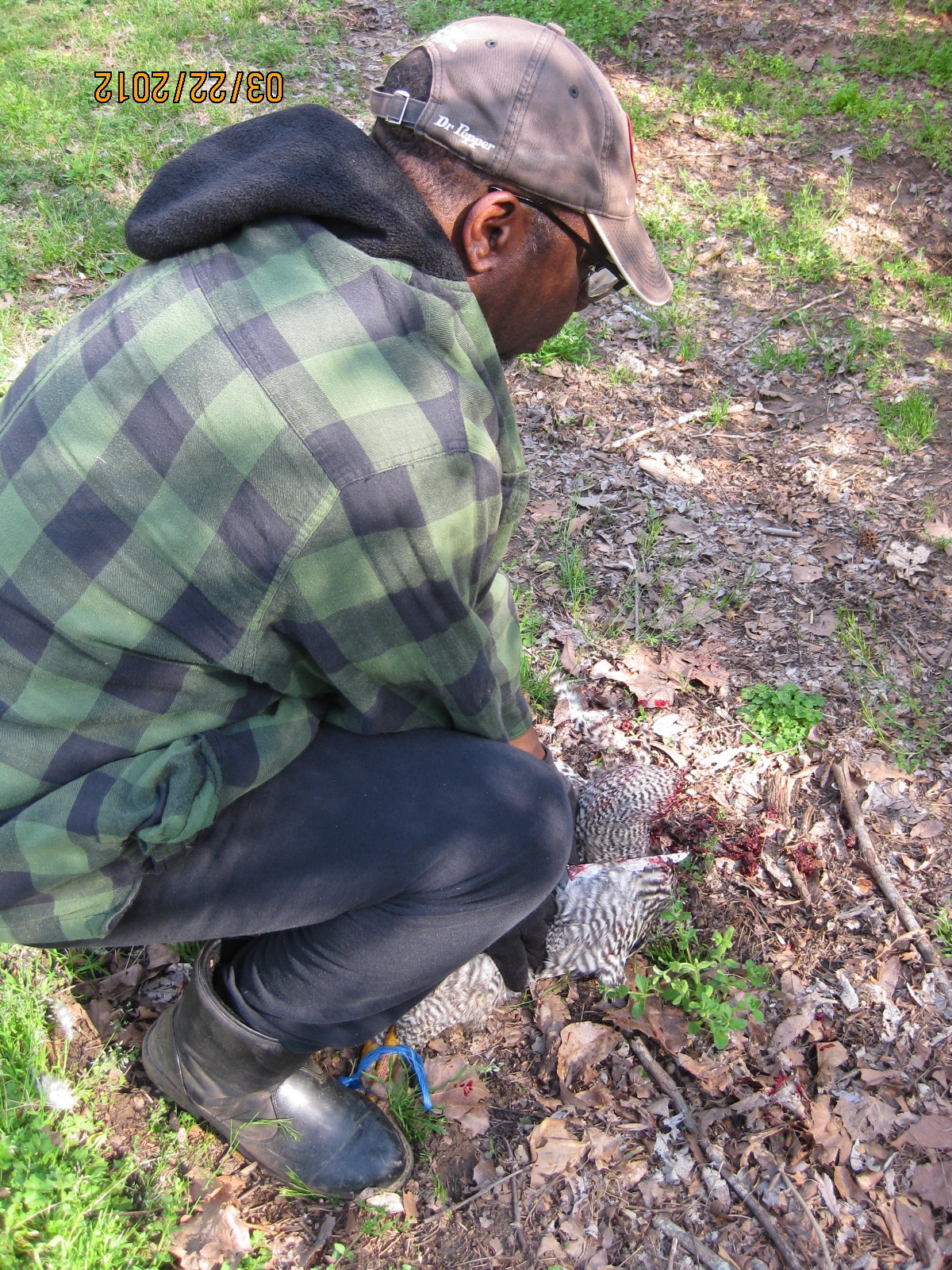
We had another first this week. Unfortunately, it was not among those we have gleefully anticipated, but rather, was one that we dreaded: slaughtering our rooster. Around 3 weeks ago, Captain Haddock started developing a nasty habit of attacking his caregivers. At first it was just occasional, but as time went on, he became more and more aggressive. It got so bad that the girls were afraid to go out to the barnyard, and scattering scratch became a nerve-wracking task. At one point, he actually grabbed our 5-year-old's shorts with his beak and proceeded to give her a 6-inch scratch down her leg. On his last day of freedom, I was walking to the coop to check for eggs when he zoomed in at me from behind. When I sought refuge inside the coop, he cornered me there, evidently hoping to peck my eyes out. I grabbed my cell phone from my pocket and called my husband, G-P. "Come save me!" I yelled. "He's gonna kill me!" My generally nonchalant man was there in a flash, waging a dramatic pursuit of my attacker. He soon had him cornered and caged. Captain Haddock had sealed his fate: he was headed for the roasting pan.

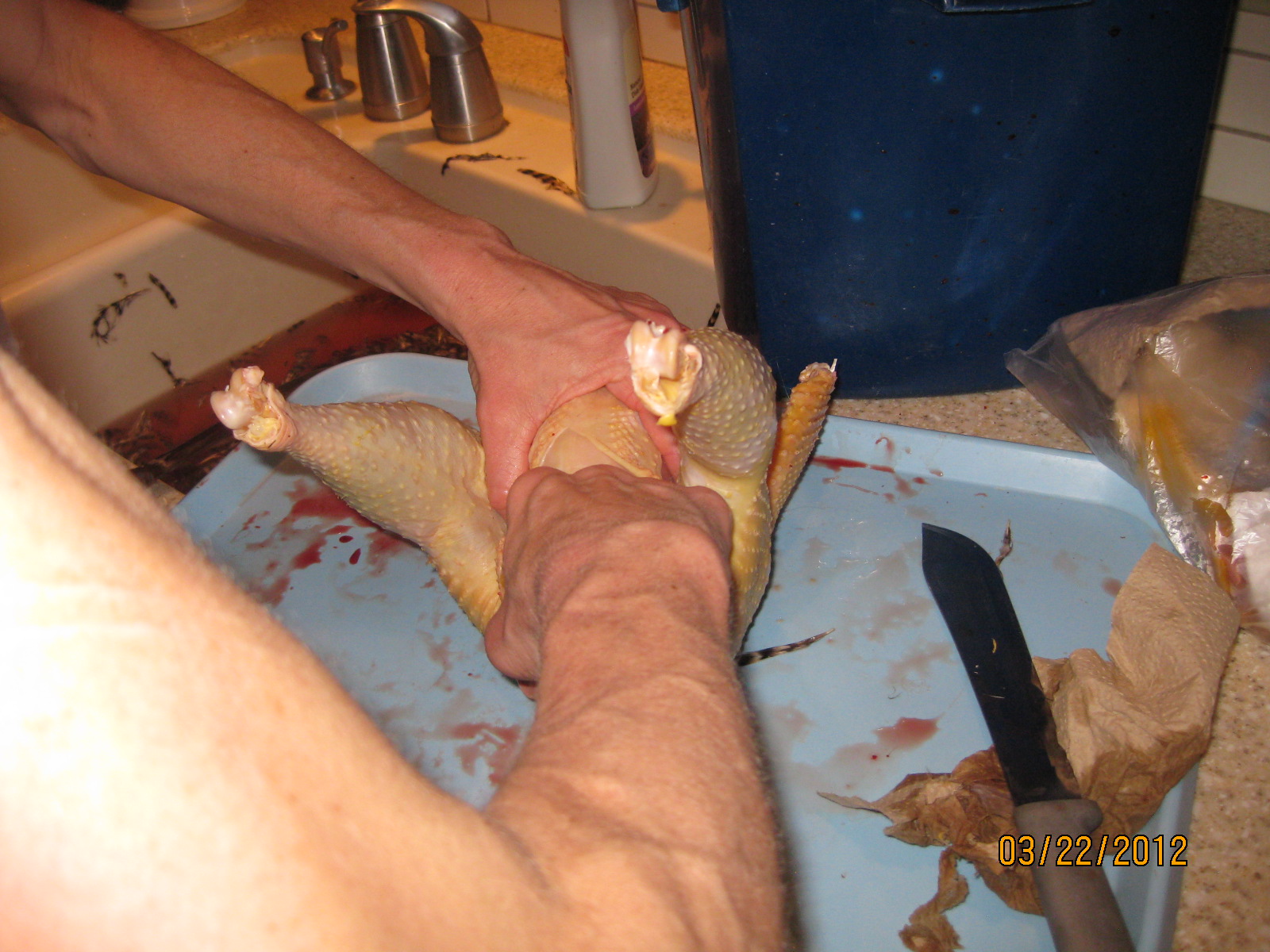
A day and half later, we hauled Captain Haddock down to the pasture, and G-P did the dastardly deed. I have to admit, I was a bit skeptical of the claims he'd been making that "I saw this done all the time back in Nigeria. It's no big deal." But he really did carry out the task like a pro. I was beaming with pride (and relief that I didn't have to do it) as I watched. Now it was my turn. We took the carcass to the kitchen. (My mother later informed me that her mother used to do this part in the yard, gently hinting that I should, too. In hindsight I have to admit that it's probably a better setting.) I dunked him in scalding water and plucked the feathers. LOTS of them. It turns out that our Mr. Big-Britches was mostly feathers.  In fact, he both looked and tasted a lot more like the little chickens I had eaten in rural Haiti than the ones for sale at the grocery store down the street. Of course none of us minded that one bit. The wilder the better is a general rule of thumb at our table. And if that means small and tough, so be it.


The girls, far from being squeamish or upset (as we'd feared they might be), watched attentively as I pulled out the innards and identified for them the liver, stomach, gizzard, heart, intestines, and lungs. We dissected a couple of items and decided to look up more information on chicken anatomy later.


After cleaning the carcass in cool water, we slipped it into the frig until the next day, when I roasted it for dinner. It was amazing: dark, juicy, slightly chewy, and delicious. We feasted, thanking Captain Haddock for the pleasure of his crows the nourishment of his meat. 

Hopefully, we'll find a sane, friendly rooster to take the Captain's place sometime soon. In the meantime, we'll all enjoy going out to the barnyard again without fearing for our safety.


Jennie's Roasted Free-Range Chicken

Preheat your oven to 375 degrees.
Place the chicken in a roasting pan and rub the cavity with a mixture of:
  • olive oil or butter
  • fresh or dried herbs, such as:
    • thyme
    • rosemary
    • oregano
    • parsley
    • basil
  • fresh or granulated garlic
  • salt and pepper.
Place in the cavity:
  • the juice of half a lemon
  • a chunk of onion
  • a piece of celery.
Rub the outside of the chicken with more of the olive oil mixture.  Bake for approximately 20 minutes per pound of chicken, or until the meat is at least 165 degrees, drizzling occasionally with more olive oil or butter.


Tuesday, March 20, 2012

Seed Starting Time: Enticement and Tips


If the gardeners in your life seem to have a special twinkle in their eyes or an extra spring in their step during the next few weeks, it may have something to do with the fact that the moment we've all been waiting for has arrived. Finally--after all those months of drafting garden layouts, sharpening tools, buying supplies, and waiting, waiting, waiting--the time has finally come to sow some seed. Is there anything more exciting than popping seeds into soil, or more magical than seeing tiny green stems emerge a few days later? Not to most gardeners.

The girls and I are attempting to grow all our own transplants this year. In the past, we have purchased at the garden center most of those delicate damsels that like to be spend their first few weeks indoors before being thrust into the none-too-gentle arms of mother nature: tomatoes, peppers, onions, cabbage, leeks, and a variety of flowers and herbs. But this year we decided to be bold and try raising them from seed. And why not, since we're getting quite used to diving head-first into new waters! In the following paragraphs, I share some of the discoveries we've made.

First, a few of the reasons that we (and many other gardeneres) have chosen to start our own seeds:
  1. Seeds are much less expensive than transplants.
  2. It is often hard--if not impossible--to find organically grown and heirloom transplants.  
  3. The variety of vegetables, herbs and flowers that you can find in seeds catalogues is much greater than what is available at most garden centers.
  4. It's fun!
The fun of starting your own seeds actually begins well before spring. In fact, almost as exciting to gardeners as popping those first few seeds into soil during the first few days of spring is cozying up in the depths of winter with a good seed catalogue. There are some out there these days that make for better reading than New York Times bestsellers. While a number are glossy and exquisitely laid out, others charm not with appearance but with poetic description--depicting their wares in terms that leave your mouth watering and your hands itching for a pair of garden gloves. Among my own favorites (all offering organic and heirloom selections) are:

Once you have your seeds ordered, it is time to figure out where they will begin their fragile little lives and how to provide adequate heat and lighting for them. It's convenient to buy a set of grow lights at your garden center, your hardware store, or online, but plain-old florescent bulbs work fine, too, as long as you rig them up so that you can raise and lower them above the seedlings. Since seeds won't germinate if they are too chilly, you'll either need to find a warm corner in your house where you can set up your grow lab or--if you're using a garage or another somewhat chilly space--you can purchase heating mats.
You'll also need to buy or make the following:
  • Seed-starting mix (do not try to use potting soil, no matter how tempting it might be)
  • Small pots (easy to find in stores but may also be made from yogurt cups, disposable drinking cups, or newspaper--there are many great ideas online!)
  • Leak-proof trays
  • A watering can and spray bottle
  • A bucket.

Now you're ready to go. First empty the seed-starting mix into a bucket and wet it thoroughly. After letting it sit for a while to absorb the water, scoop the mix into your pots. (Make sure there is a hole in the bottom of each one so that water can drain from the soil.) Plant the seeds according to the directions on each seed packet, and cover with plastic until the seeds have sprouted. Don't forget to label what you've planted! Believe me: you won't remember them all when they begin sprouting--seriously. (Old-fashioned popsicle sticks work great for this, by the way.)


You don't need to turn your grow lights on until the seeds have sprouted. As soon as they have, remove the plastic cover and leave the grow lights on around 16 hours a day or so. (Some experts say you can leave them on all the time, but that just doesn't seem natural to me.) If you have a hard time remembering to turn the lights off and on, you can get a timer for a few bucks at your local hardware store.

Keep the soil in the pots moist but not soaking wet. (It's best to water them from underneath by pouring water into the trays and letting the soil in the pots soak it up.) Raise the lights as the your seedlings grow, keeping it 2-3 inches from the tops of the plants. After a week or so, let a fan blow on them for several hours a day so that they can begin adapting to the wiles of the weather they'll soon face. When the seedlings have several leaves, thin them out and/or transplant them into bigger pots. As the time nears when you'll be putting them into the ground outside (again, your seed packets should tell you when that is), you'll want to "harden them off"--that is, move them outside for several hours a day so that they can acclimate before being put into the ground.

That's about it. Of course there are much more detailed directions in the thousands of gardening books and zillions of gardening websites out there. Consult as many as you can to learn about different approaches. Then, using all the advice that sound right to you, give it a try.

I think you'll find that no matter how many seeds you pop in the ground, the first time you see each one sprout is awe-inspiring--another one of the common yet inconceivable miracles involved in nurturing living things. Happy planting!

The Little Seed
--Kate Louise Brown

In the heart of a seed
Buried deep, so deep
A tiny plant
Lay fast asleep.

"Wake!" said the sunshine
And creep to the light
"Wake!" said the voice
Of the raindrops bright

The little plant heard
And it rose to see
What the wonderful
Outside world might be!

Wednesday, March 14, 2012

Little Gurus

"The present moment is filled with joy and happiness. If you are attentive, you will see it."--Thich Nhat Hanh

Yesterday afternoon, on our way back home from visiting some newborn goats and lambs at a nearby farm, the girls and I decided to stop off for a short stroll and some playtime at a park. While we were there, it began to rain. Since no rain was in the forecast, we had not brought umbrellas or rain jackets, so of course I suggested we head back to the car. "Why???" the girls cried incredulously. "Well, uh, we're going to get wet." "Great!" they said. So we stayed. It turns out that it really is extra-fun to swing and spin and climb in the rain. Soon, though, being the incurable adult that I am, I got concerned that my cell phone was going to be ruined and my backpack soaked through, so I insisted we go. I did consent to take the longer path to the car, and we had a lovely time dancing and singing in the rain as we went. Once back home, we hopped out of the car and immediately headed out for another quick stroll up the lane to the mailbox. (We'd "forgotten" to mail the letter we'd brought with us.) Of course, the girls were not yet ready to come inside when we returned and headed straight to the barnyard to frolic with their furry and feathered friends in what was now a downpour. When I joined them there a little while later to feed the goats and batten down the hatches for the night, they were showering under the stream pouring from the chicken coop's gutter and giggling uncontrollably.


Sadly, most of us grown-up folks seem to need reminders from religious or scholarly gurus to live fully in the present moment. We spend most of our days obsessing over what has been and/or what may be--fretting, anticipating, dreading, planning, organizing, controlling. While our productivity is often impressive, joy generally eludes us. Fortunately, there are little gurus all around us, providing endless lessons in living wisdom. Find one of them today. Take his or her hand, and ask for some pointers. I promise s/he will happily enlighten you.

Wednesday, March 7, 2012

Shrooming in the Shade

I love trees. My husband loves trees. My daughters love trees. So in many ways the property where we are now living is perfect for us. There are lots of trees here. But those trees are also making it challenging to farm. They limit the space we have for growing hay in our pasture. And they limit how much gardening I can feasibly do. This was the biggest compromise I had to make as we made the decision to buy this place last summer. And I continue to struggle with it. Before leaving Ohio, I had envisioned having a HUGE Southern garden: rows and rows of tomatoes, corn, beans, lettuces, pumpkins, sweet potatoes, and onions; a spectacularly wild array of flowers; and enough herbs to last throughout the year. But here I am, standing in front of the only little corner of our property that is even remotely capable of getting enough sun for blooming plants (it was a corner of the yard before we got here), wondering if I will be able to pull off even a small patch of veggies.

(from www.mushroommountain.com)
Determined not to keep longing for the landscape of my dreams, I've decided instead to get creative in working with the landscape we have. I hope to plant a variety of native perennials around the house; scatter trillium, wild ginger, bloodroot, and spring beauties in our little plot of woods; and use the mountains of sticks and leaves we have to generate extra-rich mulch. And I'm going to grow mushrooms. Perhaps I'd better say I'm going to try to grow mushrooms. Once again, I really don't have any idea what I'm doing.

Mushrooms are wonderful little beings. The fleshy edible fruit bodies of fungi, they are surprisingly nutritious. Low in fat, carbohydrates, and calories, they are a great source of B vitamins and essential minerals such as selenium, copper, and potassium. When exposed to ultraviolet light, they are also high in Vitamin D, something many of us North Americans are needing more of these days as we spend more and more time indoors. And if that's not enough, as my children have reminded me, they also attract fairies and elves! It's not surprising, then, that mushrooms have been harvested in the wild and cultivated by humans for at least a few thousand years. (Edible mushrooms have been found in 13,000 year old ruins in Chile, though the first solid evidence of mushroom consumption dates back to several hundred years BC in China.)

Not that long ago, many rural Americans could take a walk through a forest and gather several types of edible mushrooms to bring back for the supper table. (The same was true where my husband grew up in Nigeria, he says.). These days, though, mushrooms are among those foods that most of us--even most gardeners--assume we need to buy at the store. In fact, gathering them wild can be dangerous without a good deal of knowledge and training. But a few weeks ago, I started wondering if it's really true that I have to pick up a plastic-covered styrofoam box every time I need some fungi in my stir-fry. After all, these quirky little creatures do grow all over the woods, often popping up in what seem like the most unlikely places. So how hard could it possibly be to cultivate them? I have to admit that researching mushroom cultivation left me feeling pretty intimidated at first: lots of talk about sterilization, mycelium formation, moisture gauges, temperature sensitivities, etc., etc. But after some digging, I discovered that there are a few types of tasty mushrooms that gardeners like me seem to be able to grow with relative ease.

The one I chose to try is Stropharia rugosoannulata, commonly known as Wine Cap or King Stropharia. It grows wild in forests throughout the United States and has a lovely red, brown or tan cap that can sometimes reach the size of a dinner plate (!) but more commonly grows to around 2-5 inches across. It is evidently delicious when sauteed, broiled, or baked and is exceptionally good for you. Attractive as all these traits are, the deciding factor in my choice to cultivate wine caps was that they love wood chips. And we have lots of wood chips lying around these days. In fact, I had two large piles of sweet gum chips sitting right beside the little garden plot I mentioned earlier--under some trees at the edge of the woods (and thus in what seemed like a perfect spot for a mushroom bed). So I got online and found the website of Mushroom Mountain, a mushroom farm in Liberty, South Carolina. The nice folks there confirmed that wine caps would be a good variety for me to try, so I sent off for a bag of spawn. It arrived on our doorstep two days later.

To prepare the beds, I spread a layer of cardboard and newspaper on the ground between the two wood chip piles. Then I added a good amount of chips, leveling them out with a rake. Next, I scattered about half of the spawn I'd received over those chips and gently mixed them in. I then added another layer of newspaper, another layer of chips, and the rest of the spawn. Finally, I covered the finished bed with a layer of rotting leaves (to protect the chips from drying out and keep the mushrooms from freezing when the weather turns cold). Jeepers; that wasn't so hard.


Of course, I won't know for quite a while if this new venture into the world of mushroom gardening has been successful. It will be several months--maybe more--before the mushrooms can be harvested. In the meantime, all I have to do is keep shooing away the chickens (it took all of about 7 minutes for them to discover this new dining venue); remember to water occasionally; and dream quiet, delicious dreams of nibbling fresh, homegrown mushrooms.

Mushrooms
--Sylvia Plath

Overnight, very
Whitely, discreetly,
Very quietly

Our toes, our noses
Take hold on the loam,
Acquire the air.

Nobody sees us,
Stops us, betrays us;
The small grains make room.

Soft fists insist on
Heaving the needles,
The leafy bedding,

Even the paving.
Our hammers, our rams,
Earless and eyeless,

Perfectly voiceless,
Widen the crannies,
Shoulder through holes. We

Diet on water,
On crumbs of shadow,
Bland-mannered, asking

Little or nothing.
So many of us!
So many of us!

We are shelves, we are
Tables, we are meek,
We are edible,

Nudgers and shovers
In spite of ourselves.
Our kind multiplies:

We shall by morning
Inherit the earth.
Our foot's in the door.


Thursday, March 1, 2012

Tattooing the Kids


My twin sister was back for another visit this weekend, so a variety of long-delayed tasks finally got done. I try to always be ready for Jules with home-cooked delicacies in one hand and a hefty to-do list in the other. She doesn't seem to mind the latter and unabashedly delights in the former. (Is there a better combination than that in a houseguest? I think not!)

We started with the smaller jobs: hanging bulletin boards in the Discovery Room; nailing up a bird house in the Enchanted Garden (the name the girls have given to the circular island in front of the house); and installing a Mason Bee lodge in the woods near the area where I'll plant a vegetable garden in the coming weeks. We then moved on to helping my husband (bless him) tear out the dilapidated chicken run and spread extra wood chips around the coop and behind the barn. 

At that point, we couldn't put off any longer the most critical and most dreaded task of the weekend: tattooing the goats' ears. This is one of those tasks that--like bringing home our first load of hay and collecting our first egg--feels like a sort of rite of passage into farmerhood. While I have been a bit nervous about some of the other new responsibilities I've "winged" during the past few months, such as trimming the goats hooves, this time I was positively shaky. Perhaps the process reminded me a bit too much of the mutilation and scarification rites of passage I used to teach as an anthropology professor and, thus, seemed to have an aura more profound than most of the other tasks I've had to figure out how to do. I think I was mostly afraid I would goof it up and irreparably traumatize and/or disfigure our little friends.

Of course, I could have asked a goat breeder or a vet to come do it for me, but I figured I might as well learn how to do it myself. So I read and read, and read some more, about the importance of tattooing (it's a must for registered dairy breeds) and how to do it correctly. And I called in Jules. There's nothing as helpful in facing a daunting task as having someone by your side who thinks you can handle it, who will help you in whatever way you need, who will encourage you as you stumble along, and who will later know just what parts to laugh about.  

First we spent nearly an hour getting all the letters and numbers lined up correctly for the "applicator tool"--a devise that looks disconcertingly similar to a medieval torture instrument (a toe smasher I'd say). We then gathered up the ink, some rubbing alcohol (to sterilize the ears), a few rags, and a box of rubber gloves, and headed out to the barn. As we approached the gate, all three little goats came running toward me maaa-ing just as they always do, begging for some TLC and a bit of grain. I started to get weak in the knees. Did they look that small and vulnerable when I fed them earlier that morning? Was I really going to do this to them?

I won't relate all the gory details, but in summary can report that:
  1. I have a much greater capacity for causing small creatures piercing pain than I had imagined;
  2. My twin sister has an iron grip and a startling knack for wrestling livestock into submission (I got the feeling she could have handled a calf just as nonchalantly); and
  3. Goat kids get over trauma much more quickly and seamlessly than adult humans.
Despite all the fighting and screaming that went on during the "operations," within seconds afterwards, the goats were hopping around and chasing one another through the barnyard. They didn't even cower from me (as I'd feared they would) that evening when I went out to feed them and put them in their stall for the night. I gained a new respect for those little critters that day. And perhaps grew a bit taller in my new-farmer boots. 

In any case, I am immensely relieved to have this latest ordeal behind me. And almost ready for the next item on the "wing-it" list.

Finally done!